
Weatherwax: Preference for biofuel dev led to low dose radiation research demise
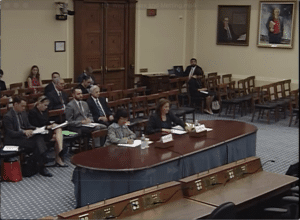
The following video is extracted from the House Science, Space and Technology joint oversight and energy subcommittee hearing examining misconduct and intimidation of scientists by senior executives in DOE chain of command.
It features the opening statements from Dr. Sharlene Weatherwax, a plant microbiologist serving as the Director, Biology and Environmental Research for the Department of Energy’s Office of Science, and Dr. Noelle Metting, a radiation and cancer biology specialist who began managing the Low Dose Radiation Research Program in 2000.
The hearing was focused on determining decisions, actions and reasoning for events that the oversight committee believed began in October 2014. Those events resulted in terminating the low dose radiation research program and attempting to fire Dr. Metting from her government service position.
Dr. Weatherwax’s testimony expresses a clear professional interest in plant biology and plant genetic manipulation that can be used to create plant species that are better suited to high productivity as biofuels. She tells Congress that the Department of Energy chose to redirect the funds from the Low Dose Radiation Research Program (LDRRP) to fund projects determined to be higher priority within the Office of Biology and Environmental Research (BER).
It’s worth noting that the annual budget for the LDRRP never exceeded $25 million and that the total budget for BER is more than $600 million. It seems like there was a lot of management attention devoted to capturing a 3% increase in funding for programs that someone determined were a higher priority than developing an improved understanding of the health effects of low dose radiation.
The saga of the rise and fall of the LDRRP is still under development; this is just a teaser with more to come.


Chuckling here. Fox news ain’t doing ya any favors. Sitting in a local eatery having breakfast, Fox news on all 3 TVs. Breaking news story is about “Energy Dept. report that claims our electric grid is in serious danger of cyber attack”. What the visual accompanying the headline? Why, an NPP cooling tower, of course.
News flash…..BOO!!!! Those nasty cyber terrorists are gonna irradiate ya!!!
So why would they pick an NPP to drive home the fear? Because they know its a fear, a resource, they have already sown and nurtured, and the easiest, and most powerful, fear to exploit.
The nurturing of radiation fear works for “them” on multiple levels. It helps rationalize an endless war against those allegedly creating those nasty dirty bombs in your local mosque. It allows the extended and soon to be massively deregulated use of fossil fuels to protect us fom the radiation boogie man. And it helps close NPPs, so that the NG suppliers can get fatter and fatter, at our environment’s expense.
I can just see Pruitt and Perry, nodding their heads, and watching this report, as their brains hear the echo of a comforting sound…..
“Ka Ching! Ka Ching!!”
@poa
Are you sure it was a cooling tower associated with a nuclear plant?
Perhaps you, like a large portion of the country, associates hyperbolic cooling towers with nuclear because of TMI imagery. Ever wonder why the Diablo Canyon and San Onofre plants in your home state looked so different from conventional images of nuclear plants?
Have a look at the Crystal River power station. Neither of the cooling towers was used for Unit 3, which was the only nuclear unit on a 5 unit site.
http://2262-presscdn-27-11.pagely.netdna-cdn.com/wp-content/uploads/Crystal_River_Power_Station.jpg
“Perhaps you, like a large portion of the country,….”
Yep.
Thanks for underscoring my point.
I have seen a lignite combined heat and power plant with a hyperbolic cooing tower in Brno, Czech Republic.
cooling tower
And yes, the Czech spelling is Brno.
And another author blasts LNT:
https://www.sciencedaily.com/releases/2017/01/170109150038.htm
But there is no surprise to me.
@David B. Benson
It’s hard to tell if you are being supportive or dismissive.
It’s not exactly “an author”, but a team of three rather well-experienced, respected, credentialed subject matter experts that have published a peer reviewed paper in a high quality journal for other professionals in the field to read.
The conclusions of the paper are certainly no surprise; they have been known to be true among a rather large segment of the people working in the area for decades. The fact that they were published in such an established journal and that the journal editor thought the paper was important enough to issue a press release about that particular section of an issue does surprise me just a little bit.
On the other hand, I’ve often said that “reality bats last” and believe that the truth will eventually win over even when the “Big Lie” has been firmly entrenched, continues to serve the interests of powerful people and is staunchly defended by its propagators.
Trying to be helpful. Wade Alison’s book was enough to convince me. Well, together with a paper from a researcher at LLNL on DNA repair mechanisms.
This is more evidence that the regulatory requirements for ionizing radiation are based on a falsehood.
I thought Congress controlled the purse.
If Congress explicitly funded the Low Dose program,
how can DOE switch the money to other stuff?
Indeed.
My understanding is that people can go to prison for such things. In this case, everyone involved ought to. Their confiscated assets and forfeited pensions should be used to re-assemble the body of expertise they so maliciously destroyed.
They do, and that’s why this is so important. Congress can’t use the purse effectively unless they have honest information to go on.
All of this controversy centers around a briefing for Congressional staff members related to a House bill that would have funded further research into the effects of low-dose and low-dose-rate exposure to radiation. Naturally, as head of the LDRPP, Dr. Metting presented on her program at this briefing.
Dr. Metting’s superiors told her essentially to lie in this briefing, or at the very least, not tell the staffers all of the truth (which would be considered the same thing as lying, if under oath). When she did not follow their orders and presented what she believed was the truth, they fired her.
The DOE was not switching money; they were trying to influence where the money goes by lying to Congress. Then they ended up punishing an employee who decided to tell the truth.
Thanks for the explanation. Seems like the DOE
tactics worked despite Metting’s courage. The
next question is why?
@Jack Devanney
That is one of the big questions I’m seeking to answer in my coming piece. Another one is “who”.
As a former “faceless bureaucrat”, I believe that naming names is one of the ways to improve on our current government processes and make them more about serving the people who are supposed to own the government.
I’m a bit of an idealist re: “Government by the people, for the people”
I wonder if Weatherfax pointed out that
biofuels are radioactive, gas and oil far
less so. So we kill the low dose program
because it does not support LNT
and switch the money to a program
that according to LNT is going to kill
people. Tough to be idealistic about
such a government.
@Jack Devanney
In this case, it looks like the specific direction from Congress to fund the program included language describing it as a “10-year” program. That period ended in 2009 or 2010, depending on whether or not you count the first year of organizational funding, which was a substantially smaller annual amount before research grants were awarded.
The sponsor of that specific legislation, Pete Domenici, was no longer in office and was not there to protect the funding. DOE began the efffort to defund the LDRRP by realigning the program and putting it under Biological and Environmental Research.
https://atomicinsights.com/low-dose-radiation-research-program-defunded-2011/