

Kairos Power Is Hiring For Hybrid Natural Gas-Nuclear Power System
As long-established nuclear system vendors falter under the weight of challenges that often burden mega-projects, a growing herd of start-up companies envision an exciting future in innovative nuclear solutions to the world’s energy trilemma.
One of the newest additions in the space is Kairos Power, an Oakland, CA-based start-up that is quietly assembling a team capable of commercializing their FHR (fluroide salt-cooled high-temperature reactor).
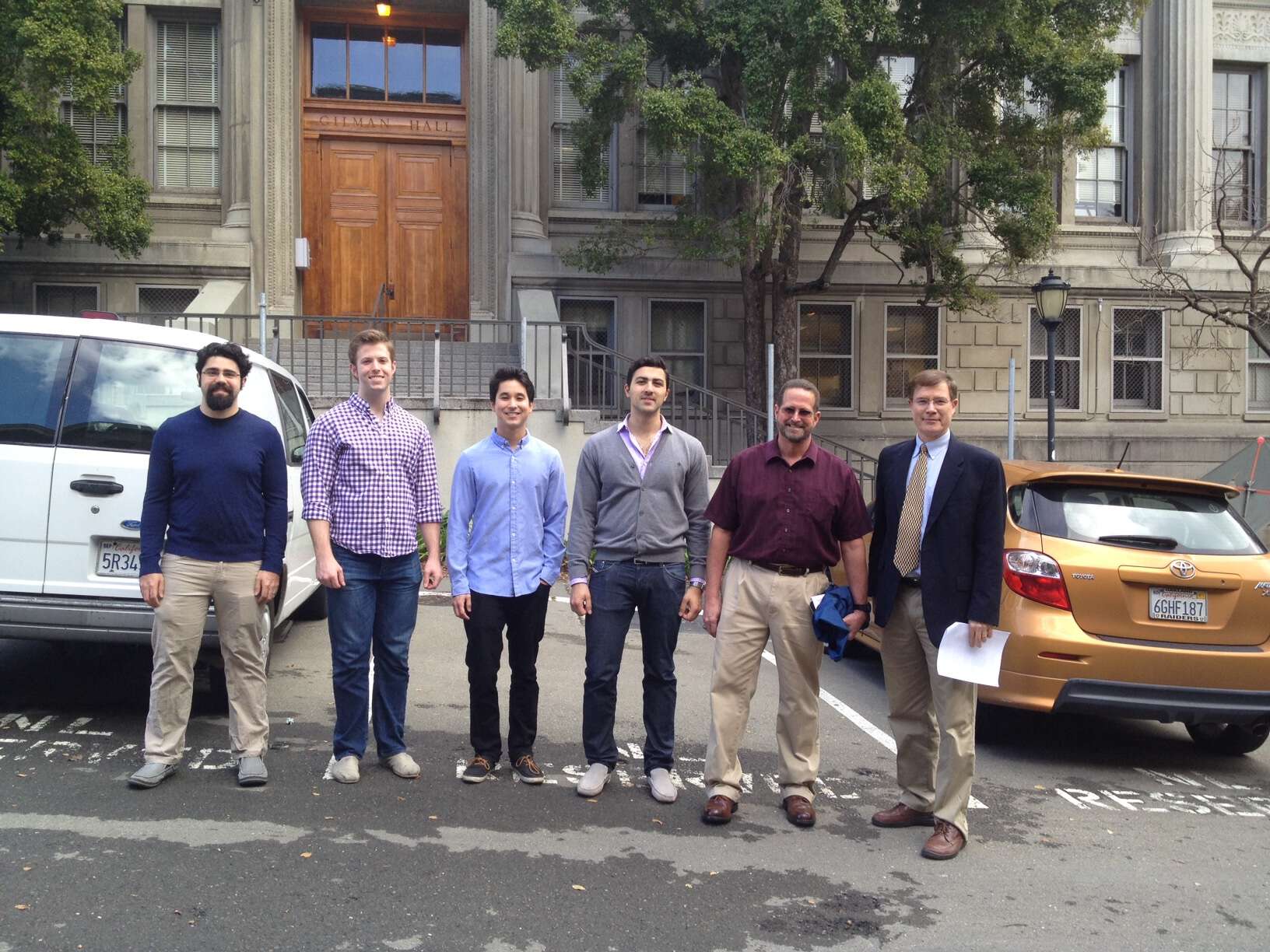
With Rod Adams and Per Peterson in front of historic Gilman Hall. Feb 2015
Their technology is a system whose major components and integration modeling has been under development for several years. The research, conducted mainly at the University of California, Berkely (UCB) and Massachusetts Institute of Technology (MIT), has led the developers to believe that a hybrid system that uses both nuclear fission heat and natural gas heat can be a clean, competitive source of dependable, flexible power.
Aside: I had the opportunity to visit UCB and speak to the Nuclear Engineering Department a couple of years ago. During that visit, I toured several of the lab facilities where FHR components were being modeled and tested. End Aside.
The privately-held company’s founders recognize that too much exposure too early can result in inflated expectations. They are experienced enough to know that nothing moves very fast in the energy industry, especially in the nuclear segment of the industry.
Dr. Per Peterson, a well-known nuclear engineering professor at UCB, is a Kairos consultant. Here is how he responded to a recent information inquiry.
A risk with nuclear start ups is that excessive hype can damage credibility. The company is currently in the early phases of recruiting, meaning that the major external focus is on providing information to universities for recruiting purposes.
In addition to the company website, which includes a list of current positions that the company is seeking to fill, Dr. Peterson said that the best available summary of Kairos’s current situation is available on its LinkedIn page.
Kairos deserves to have the space and patience needed to develop its technology, licensing and commercialization plans. Its current goal is to build a demonstration prototype by about 2030. Following testing and refinement, Kairos expects to be ready to enter the commercial power market in the late 2030s.
Though that kind of long-term thinking turns some people off, it’s worth remembering that someone who wants to be a medical doctor by 2030 and a respected specialist by the late 2030s should be working on early steps towards those goals now. If the work has not already begun, it must start in the near future in order to enable a reasonable probability of achieving those worthwhile objectives.
For engineers who want to invest their career in developing machinery and integrating systems that might help solve some of humanity’s most wicked problems, it might be worthwhile to get onto Kairos’s mailing list.
Note: A version of the above post was first published on Forbes.com and is reprinted here with permission.


This is really, really good news. Economics always wins the argument and this proposal looks convincing.
Here’s how it works.
https://www.youtube.com/watch?v=2zD0m_ci-oo&t=1463s
They should focus on the Air-brayton Combined Cycle part more than the FHR part. By decoupling the balance of plant from the reactor, they can bring it to fruition more quickly. Coal, other new gen nuclear, CSP, even geothermal can benefit from this technology. The income from that can then go into realizing the FHR.
I have been following the development of the Mark 1 Reactor design at the University of California, Berkley for some time. The design is promising as a source of base load power, that could also produce added peak load electricity. By using existing GE Combined cycle, and linking a nuclear power source on to the front in. The reactor itself offers an inting design that bombines peffle Bed fuel with Molten Salt cooling.
This is great news and, thankfully, is not the only idea out there.
http://www.hybridpowertechnologies.com
There’s also this.
http://www.moltexenergy.com/learnmore/Moltex_Renewables.pdf
Which takes the FIRES part from the FHR/NACC/FIRES proposal and uses salt instead of firebricks.
http://web.mit.edu/nse/pdf/researchstaff/forsberg/FHR%20Description%20January%202015-3.pdf
One of the major technical problems for molten salt designs, all of them, seems to be proving out the long term corrosion resistance of the reactor vessel and primary plumbing. Hopefully, the several companies promoting these designs can collaborate on the corrosion issue and focus limited startup funds on the particulars of their individual designs, as opposed pumping out their various internally made white papers on the pros and cons of Hastelloy-N, etc.
@Falstaff
The solution being implemented at at least two of the major molten salt reactor designers is to treat the materials that are exposed to high temperature salt and a neutron flux as replaceable components that only need to last for 4-7 years instead of 60 years. Apparently there are known and proven materials that can resist corrosion in hot molten salt environments as long as they are not also embrittled by irradiation.