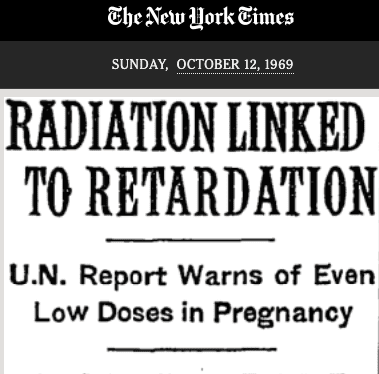

Jim Hopf recently published a thought provoking post on ANS Nuclear Cafe titled New EPA Guidelines for Response to Radioactivity Releases. In that post he points out the illogical way that the EPA applies and enforces its assumption that any ionizing radiation is hazardous, even down at levels far below natural background.
Jim points out that under current rules, nuclear power plant operators, former weapons manufacturing sites, and used fuel repositories are required to continue clean-up efforts until models show that the most exposed person will receive a dose rate of somewhere between 10 and 25 mrem per year.
Aside: As a point of reference, the average American is exposed to about 300 mrem per year, but those doses vary over a wide range to the point where the most exposed may get 1000 mrem. Around the world, there are places like Ramsar, Iran where the most exposed can receive 26,000 mrem (260 MSv). “Cytogenetic studies show no significant differences between people in the high background compared to people in normal background areas.” End Aside.
Depending on the isotopes involved, 10 to 25 mrem/year is the dose rate at which the EPA’s application of the linear, no-threshold dose response assumption leads to a calculation of between a one in ten thousand and a one in a million chance of early mortality as a result of exposure to radiation for a person that stays in the area for a lifetime. (The EPA’s LNT model assumes that a dose of 1750 mrem accumulated over 70 years of chronic exposure has the same health effect as a dose of 1750 mrem accumulated in a few seconds as a result of an atomic bomb explosion.)
The illogical part of the way that the EPA applies its model in the form of enforced regulation is that no other source of radiation is held to that standard, even though there is no disagreement among scientists and medical doctors that specialize in radiation about the fact that human physiology cannot distinguish between “natural” and “man-made” doses of ionizing radiation. Radiation health effects are determined by the type of radiation and the energy level, not by whether it originated from naturally occurring radium, radon, potassium, uranium, thorium, or cosmic radiation or whether it came from strontium, technetium, cesium, iodine, uranium or plutonium that spent some time inside a reactor.
Jim does not challenge the LNT; he challenges the fact that it is applied differently to exactly the same kinds of radiation based on the source of the radiation. He also points out the enormous cost (which is revenue to some people) associated with attempting to clean up areas to levels that are 1/30th to 1/12th the average level of background radiation. Simply measuring that level of contamination requires expensive equipment and skilled technicians.
Read more »