
Atomic Show #266 – Seeing the Light about atomic energy potential
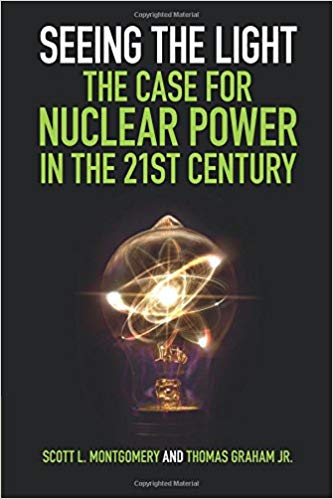
Facing the immense threat of climate change, the need to power several billion more people and the continuing reluctance to use the most powerful tool available, Scott L. Montgomery and Thomas Graham Jr. realized that there was an information and perception gap about nuclear energy of roughly equivalent magnitudes.
Their desire to help fill the gap with reliable, carefully researched information inspired them to write Seeing the Light: The Case for Nuclear Power in the 21st Century.
On March 7, 2019, I spoke with Dr. Montgomery. I learned that he, like so many of today’s effective nuclear energy communicators, once considered himself part of the antinuclear movement. He was influenced by the activists of the 1960s and even laid down in front of a bulldozer to protest of building the Shoreham Nuclear Power Plant.
Like many of the protesters of that era, he did not trust big business or the government; after all, they had been working together to keep the war going in Vietnam for more than a decade and apparently – to the protesters – didn’t care much about the opinions of the public.
As a geologist, he worked for a while in the oil and gas industry. Then, when reentering academia, he was assigned to teach courses about energy. He realized during his preparation for those courses that he needed to learn more about nuclear energy.
As a scientist, he approached the topic willing to understand and to revise his position if evidence proved that he had been wrong in his initial reaction to nuclear energy. The fact that he decided to write a book emphasizing the importance of nuclear energy in the dual goal effort to both reduce emissions and increase the amount of power available to society provides a hint about where his research took him.
The discovery of the evidence that changed his mind makes a fascinating story. You might learn something new from listening to it.

Podcast: Play in new window | Download (Duration: 1:36:36 — 88.6MB)
Subscribe: RSS


Thanks Rod for the interview and for letting us know about the book. Dr. Montgomery has a short video, Global Approach to Nuclear Energy, at http://www.youtube.com/watch?v=22IfuM6VH6A . I love the contrast between the expansive video title – ‘Global Approach’ – and its length, one minute 42 seconds.
As someone without a conversion story (I read the occasional schlock TV-derived book as a kid and one of them was from “Voyage to the bottom of the sea”, so I never was anything but favorable to nuclear power) it’s good to see those who’ve switched camps and what prompted them.
The sad stories are those of people who are already converted, but don’t dare say so out loud because they fear alienating all of their still-brainwashed followers.
The mention of the Hanford N reactor vs Chernobyl missed the fact that, unlike Chernobyl, the N reactor had a higher fuel to moderator ratio that previented an excursion like what occurred at Chernobyl. I realize to the public this may be thought of as a nuance, but such design features can make a big difference.
Rod,
Before I listen to this podcast I want to ask you a question: why do you support a carbon tax rather than a radiation tax? Does not hydrocarbon resource acquisition, as well as hydrocarbon burning, release all manner of measurable radiation? Would not demand for a radiation tax be a more effective way to attack the Linear No Threshold Hypothesis?