
Senator Carper advises Chairman Jaczko to follow the golden rule
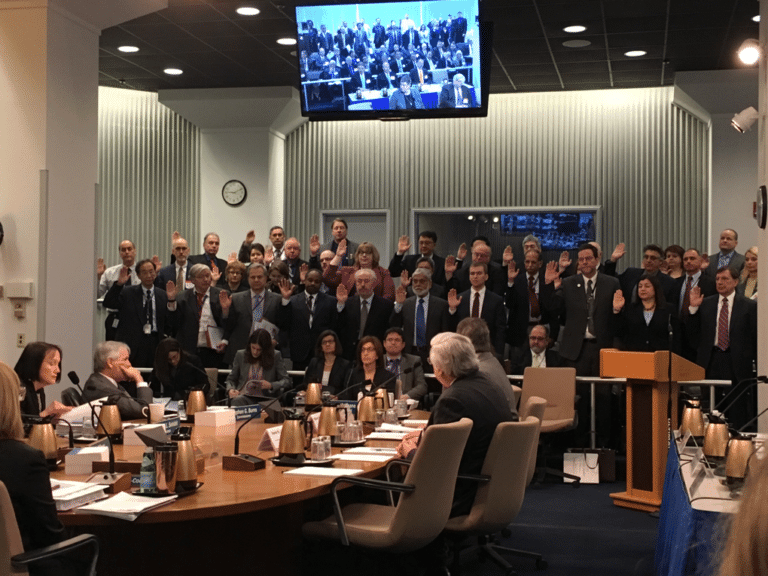
Senator Tom Carper (D-DE) is a retired US Navy Commander and a former governor of the state of Delaware. In the below clip taken from the December 15, 2011 hearing held by the Senate committee on Environment and Public Works, he offers some sage advice to the inexperienced and poorly trained Chairman of the Nuclear Regulatory Commission (NRC).
Aside: I use the word “inexperienced” because during earlier testimony Greg Jaczko admitted that the largest organization that he managed before being appointed to his current role as Chairman of the 4,000 person strong NRC was a personal staff of about half a dozen people.
I use the phrase “poorly trained” because I am guessing that he rarely, if ever, attended any leadership or management classes either before after his promotion. Those important skills are not bequeathed at birth or as a result of obtaining a PhD in particle physics, but they can be taught and learned. I am willing to be contradicted about my guess. End Aside.
After watching the full committee hearing and the hearing by the House Oversight committee on December 14, I have little to no optimism that Dr. Greg Jaczko will follow the advice. As most counselors will agree, the first steps in any self improvement program are an admission of the need for a change and a desire to make the necessary behavioral changes. Jaczko’s denials and self justifications indicate that those first steps have not been taken.


I rest my case. The Union of Concerned Scientists and the Vermont Anti Nuclear Group support NRC Chairman Jaczko:
http://www.publicbroadcasting.net/wamc/news.newsmain/article/0/0/1886385/WAMC.New.England.News/Nuclear.Watchdog.Group.Urges.Vermont.to.Support.NRC.Chairman.During.Agency.Infighting
On the experience bit: here is another angle:
Does anyone know how Dr. Jaczko’s executive experience compares to the chief nuclear regulators of other countries with long standing nuclear industries?
For instance, Dr. Weightman in the UK has has thirty-four years management experience in his agency and prior to being director headed the division responsible for site inspections. Perhaps there are downsides to working in the same agency for too long and becoming “stuck in ones ways” or becoming complacent, but that would only happen if there is insufficient means of oversight from other bodies/ political actors.
How do you think the head of our NRC is viewed by his peers internationally? Does that matter – good, bad or indifferent?
Linda J. Keen was President of the CNSC during the so called “isotope crisis” when AECL was ordered by her to shut down the NRU, then the reactor making 60 per cent of the world’s supply of medical radioisotopes. She was removed from office by an extraordinary measure passed by the Canadian Parliament (unusual as normally these roles are independent of political influence.)
Her only qualifications for the job were her connections with the Liberal Party of Canada as her academic and professional background had been in the agri-food sector (she held an MSc in agriculture sciences.) Prior to her appointment, she had no experience in any nuclear related field.
Yet, she still managed to win appointment to the Chair the International Nuclear Regulators Association (INRA) in 2003 and also to the Presidency of the International Convention on Nuclear Safety. Thus it would seem that the international nuclear regulatory community does not place much weight on technical qualifications when it comes to judging their peers.