Crash course in outrage management

A couple of days ago, Andrew, an Atomic Insights contributor pointed me to Dr. Peter Sandman, a man who built a career out of helping large organizations improve their ability to communicate about risk. I want to thank Andrew for helping me to put a name to a topic that I’ve been wanting to study – outrage management.

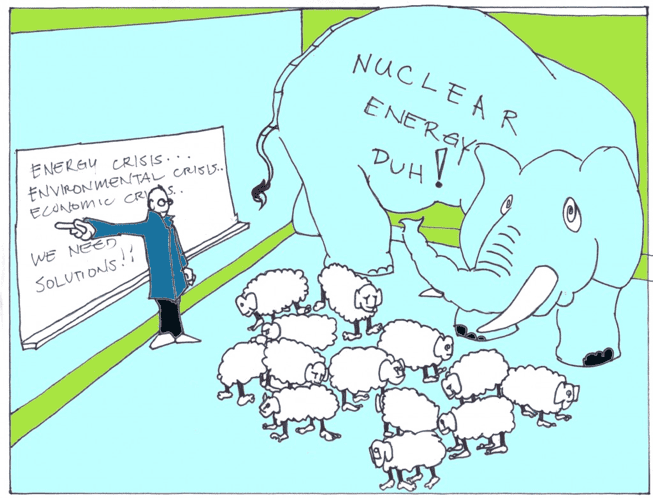
I’ve been searching for a way to improve our ability to calm the fears that have made investments and careers in nuclear energy more risky than they should be. In the 1980s, Dr. Sandman formulated an equation for risk.

Risk = Hazard + Outrage

In his formula, hazard is the classic measure that risk assessment professionals have been taught: risk = consequences x probability of occurrence. Outrage is a measure of the risk that people believe an activity entails. It is just as real and may even be more measurable than hazard even though it does not normally result in any blood, injuries or dead bodies.

After all, anyone who has engaged in an exercise in probabilistic risk assessment understands that practitioners call some of the numbers associated with computing the hazard of rare events SWAGs (silly, wild ass guesses). (Aside: Some of my distinguished friends who engage in risk assessment insist that the source of their numbers as “expert elicitation”, but I like to tease them a little. End Aside.)

In contrast, outrage is often quite visible and measurable to an accuracy of several decimal places. At its extreme, outrage can result in injuries (people being trampled by a panicked crowd trying to leave a place of perceived danger), illness, and even death. It can cause long term negative effects and entail huge economic costs.

According to Dr. Sandman, outrage management is the type of risk communications effort that is needed when the risk of an activity is dominated by outrage. Even if there are rarely, if ever, any dead bodies, –indicative of a low level of hazard — nuclear energy often tops the lists of risky activities in polls that ask people to rank a set of activities.
Read more »

Mark Lynas describes anti GMO conspiracy to Cornell University

One of the primary reasons I am sharing the above video is that it has an analog in the multi-decade effort to restrict the growth of nuclear technology. Though not the topic of this talk, Mark pointed out the similarity between the anti GMO and antinuclear movements. At minute 15:30 he said: Indeed, in many [...]

Read more »

San Onofre steam generators – honest error driven by search for perfection

Mitsubishi Heavy Industries (MHI), the supplier that sold four new steam generators to Southern California Edison (SCE) for the San Onofre Nuclear Generating Station (SONGS), has issued a redacted version of its root cause analysis of the u-tube failures that have kept both of the station’s 1100 MWe units shut down since January 31, 2012. [...]

Read more »

Is Bill McKibben really serious about climate change?

Submarine Under Ice

Andy Revkin recently published a post on his Dot Earth blog titled A Communications Scholar Analyzes Bill McKibben’s Path on Climate. In one of the videos that is embedded in the article, Matthew Nisbet describes Bill McKibben as a public intellectual and compares his activism on climate to that of Rachel Carson on the effects [...]

Read more »

US EPA dose rate standard of 15 mrem/yr for long term disposal makes no sense

Matt Wald responded to the comment I described in my post titled Too Hot to Touch – Matt Wald’s review of new book on nuclear waste issue. As a brief reminder, in that post I told him that he and the authors of Too Hot To Touch were misinforming the public by stating that the [...]

Read more »

Too Hot to Touch – Matt Wald’s review of new book on nuclear waste issue

Matt Wald of the New York Times recently reviewed a new book on America’s nuclear waste storage saga titled Too Hot to Touch: The Problem of High-Level Nuclear Waste. Aside: Sadly, Matt’s post was one of the last posts ever published on Green, which just announced its demise due to budget constraints. It’s a crying [...]

Read more »

Cure climate crisis by shifting to Fission, Fast!

Know New Nukes

Randy Olson’s post about the contribution of a short, alliterative slogan to the mass attraction of the No Nukes movement inspired my recent post about using Fission Fast! to inspire effective action to improve our climate situation. Olson has responded to that proposal with his own idea in a post titled Curb Carbon or Fission [...]

Read more »

Virtual silence at “Golden Fleece” award news conference for SMRs

Taxpayers for Common Sense (TCS) trace their heritage to William Proxmire, a senator famous for his “Golden Fleece” awards for wasteful government spending. Yesterday, the organization held a press conference to announce that they had decided to award a Golden Fleece to the US Department of Energy SMR (small modular reactor) program. The press release [...]

Read more »

Atomic Show #197 – Radium, educational museums and Voices for Vermont Yankee

On Sunday, February 24, I gathered a group of fission fans to talk about a number of nuclear energy related topics. We discussed Romance of Radium and how perceptions about radiation have been molded over the 76 years since it was produced. Then, people had learned enough about the benefits of using power emitted from [...]

Read more »

Atomic Show #196 – Atomic Optimists

On Sunday, February 17, 2013, a group of five nuclear energy professionals gathered to share their thoughts about the current state of the atomic energy business. Participants included: Margaret Harding (@M2harding), 4 Factor Consulting Meredith Angwin (@yes_VY), Yes Vermont Yankee Andrea Jennetta (@NuclearBuzz), Fuel Cycle Week and I Dig Uranium Cal Abel (@cal_abel), PhD candidate [...]

Read more »

What can Chatham, VA learn from Mt Airy, NC?

The leaders of Virginia Uranium need to talk with the leaders of the North Carolina Granite Corporation. VA Uranium is seeking to obtain permission to mine its granite formation while NC Granite is the current operator of a granite quarry that has been in continuous operation since 1889. If you will forgive the obvious pun, [...]

Read more »

Use all the electricity you want; we’ll make more

While participating in a discussion thread associated with my recent appearance on Dot Net Rocks, I remembered I’ve been meaning to write a post recommending that the the electricity production industry change its attitude about electricity conservation. For many complex reasons, the power business is one of the only industries I can think of where [...]

Read more »