
Wear green today in honor of St. Patrick and nuclear energy

Later today, March 17, 2015 (St. Patrick’s Day),
Californians for Green Nuclear Power will be donning the green and holding a rally at the plaza in front of the San Luis Obispo County building at 1055 Monterey from noon until 1:30 PM (PDT).
They want to show that the groups fighting to shut down the Diablo Canyon Nuclear Power Plant don’t represent the views of the majority of the local residents. The opposition is currently taking at least two paths aimed at forcing the plant to shut down.
One path is an effort to force the ocean front plant to stop using the abundant, readily available sea water for cooling the plant’s steam turbine condensers. They say that the plant should install enormous, ugly, fresh water consuming cooling towers at a cost in excess of a billion dollars plus an extended plant shutdown.
The other path is to claim, despite the judgement of the NRC, that the plant has insufficient safety margin against seismic movement. A former NRC inspector at the plant is fighting a lonely battle by insisting that the plant is in technical violation of its operating license; his view is a minority of one in a large, technically competent agency.
No power option can replace Diablo Canyon without a sharp increase in both electricity costs and air pollution, including a substantial increase in greenhouse gas emissions.
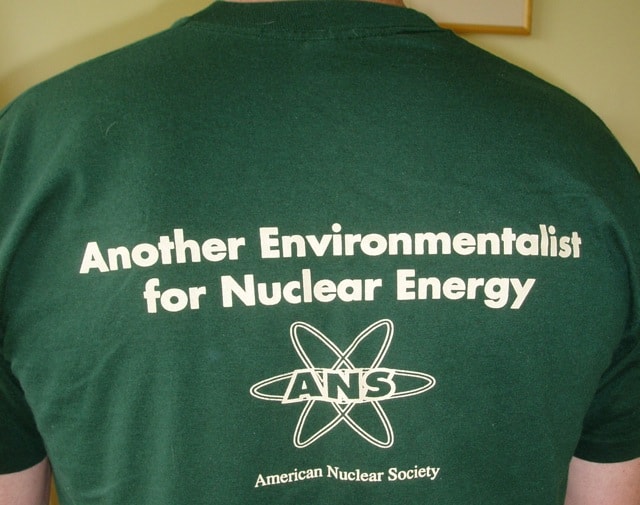
Please join the Californians for Green Nuclear Power to show your support for their effort to save a valuable, environmentally friendly power plant. If I could be there, I have a perfect shirt to wear.
Wearing the green at a public meeting
When I was searching the Atomic Insights archive for the above image, I stumbled across a short speech that I made at an NRC-hosted public meeting wearing that tee shirt. The meeting took place in January 2012 in Gaffney, SC, the home of Frank Underwood, now the President of the United States on the Netflix show, House of Cards.
I enjoyed reliving the experience of participating in a civil public meeting, even thought my talk was not popular among all of the attendees. Following the meeting, I had some pleasant conversations with the antinuclear activists that had arrived by bus from Asheville.
I apologize for the quality of the video — the camera focus function was going wacky — but the audio worked pretty well.
PS – Not long ago, a drive-by commenter using the pseudonym “Name Withheld” suggested that I “might be a thin skinned wuss wearing a suit.”
That person doesn’t know me very well. I may occasionally wear a suit, and I might sometimes act as if I am thin-skinned, but few people would call me a wuss. 🙂


“They say that the plant should install enormous, ugly, fresh water consuming cooling towers at a cost in excess of a billion dollars plus an extended plant shutdown.”
Nat draft CTs don’t generally consume fresh water. They’d use the same water source as direct intake for fill and make-up (for plume loss). However they operate as an evaporator, so the water would get “briny” requiring a lot of blow down flow so it would still dump a lot of waste heat via that. So probably not a lot to be gained. Antis just use anything possible to cause financial pain.
PVNPP is running 3 units on forced draft (fans) CTs using the sewage from Phoenix, again not exactly fresh water.
Ugly is relative, I find the double fence on the AZ/Mex border in pristine Sonoran Desert in my home town quit ugly, not to mention it is so lit up it never goes dark at night for the folks who live close.
Rod: Thanks for the recognition. Actually the opposition plan regarding proposed Clean Water Act (CWA) Section 316(b) compliance is far worse than you describe. The opposition wants DCPP to be the first nuclear power plant in the U.S. to use SEA WATER in the proposed cooling towers!
I heard the Friends of the Earth consulting engineer Bill Powers, P.E. falsely allege at a public meeting of the Diablo Canyon Independent Safety Committee (DCISC) on October 14, 2014 that the Hope Creek Nuclear Power Station (HCNPS) in southern New Jersey uses sea water in its cooling tower. The reality is that HCNPS uses brackish water from the Delaware River, with a salinity about 1/5 that of seawater. Powers also noted Palo Verde uses reclaimed water, which raises the total dissolved solids (TDS) without properly noting that the TDS in Palo Verde cooling tower water is substantially less than the projected TDS of 1.5 times concentrated as sea water that would occur if DCPP were to be forced to use sea water in the proposed cooling towers.
I have made it very clear in my DCISC and in my 18 November 2014 California State Water Resources Control Board (SWRCB) public testimony that the use of sea water in cooling towers would create an unsafe situation where some 18 million gallons of highly-conductive concentrated sea water UPHILL from DCPP’s critical safety systems such as EDGs, emergency batteries, and switchgear could create a “manmade Fukushima Dai-ichi – without requiring an earthquake!” A mechanical failure or a valve set incorrectly could trigger such an accident scenario. See: http://www.waterboards.ca.gov/water_issues/programs/ocean/cwa316/docs/cwa316cmmnts110414/gene_nelson.pdf and http://www.waterboards.ca.gov/water_issues/programs/ocean/cwa316/docs/cwa316cmmnts110414/andrew_benson.pdf
Note also the substantial salt drift from the millions of pounds of salt drift from the proposed towers would compromise the safety and reliability of DCPP as it caused flashovers of the 500kV insulators and contamination of millions of gallons of emergency deionized water stored in two large pools at the 310 foot elevation.
I also noted the specific exemptions from 316(b) compliance that were provided for nuclear power plants by the federal EPA in the passage of the CWA legislation in light of their unique environmental benefits. I urged alternative compliance as set forth in the SWRCB’s 19-page “Appendix A” that explicitly mentions DCPP several times. http://www.swrcb.ca.gov/water_issues/programs/ocean/cwa316/docs/otc_2014.pdf
The SWRCB has not set a date for making public its staff recommendations for DCPP once-through-cooling. I strongly urge interested advocates for nuclear power to promptly submit their support for Appendix A alternative compliance for DCPP to:
Ms. Shuka Rastegarpour
Environmental Scientist
Ocean Standards Unit/ Division of Water Quality
State Water Resources Control Board
California Environmental Protection Agency
(916) 341-5576
Shuka.Rastegarpour@waterboards.ca.gov
For the record, please also copy your submission to the SWRCB Board Secretary
Jeanine Townsend, Clerk to the Board
State Water Resources Control Board (SWRCB)
1001 I Street, 24th Floor
Sacramento, CA 95814
(916) 341-5600 Voice
Jeanine.Townsend@waterboards.ca.gov
Exactly. The extremely high salinity blow down water returned to the ocean would likely create a dead zone for marine life. Then that would become the anti focus. IMO hard core antis don’t even care about the particular technical issue they harass you with. They are just using it because the system allows them to. For about the price of a postage stamp they can make claims and ask questions a utility can spend millions of dollars answering. That’s all they want; to wear you down financially until you give up and pull the plug.
So why don’t utilities use the same legal process to recover financial losses? If someone harms you financially with a frivolous or false claim you can recover damages in court. As long as antis have no financial skin in the game, they will continue. But they will stop if it starts to hurt them financially.
Excellent points! Organizations such as Friends of the Earth have “deep pockets” as their most recent IRS 990 filing showed annual income around $7 million.