
Argentina pours nuclear grade concrete for CAREM, a 25 MWe SMR
On February 8, 2014, Argentina poured its first nuclear grade concrete for CAREM-25, an integrated pressurized water reactor (iPWR) whose design has been in intermittent progress for more than 24 years. Will Davis wrote an informative piece titled Argentina carries torch for SMR construction about the design and the project at ANS Nuclear Cafe.
Argentina has a long history of nuclear energy research, development and operation; it set up its Atomic Energy Commission in 1950. Two operating nuclear reactors produce approximately 10% of the country’s electricity; a third reactor is undergoing its final steps before commissioning.
Argentina is capable of producing nuclear fuel; not only does it supply its power reactors, but it has designed and supplied research reactors in Argentina, Egypt, Algeria, Peru and Australia. The research reactor program included one designated RA-8 that was specifically designed to test the fuel designed for CAREM.
The CAREM-25 will produce approximately 25 MW of net electrical power from an indigenously produced reactor core that will provide approximately 100 MW of thermal energy. The Argentinian government plans to invest 3.5 billion pesos ($455 million at current exchange rates) into the prototype project, including the infrastructure developments required to be able to produce the pressure vessel and other major components. Under the current schedule, the plant will receive its first fuel load in 2017.
According to CNEA, the Argentinian National Atomic Energy Agency, at least 70 percent of the components will be supplied by domestic Argentinian companies meeting full international nuclear quality standards.
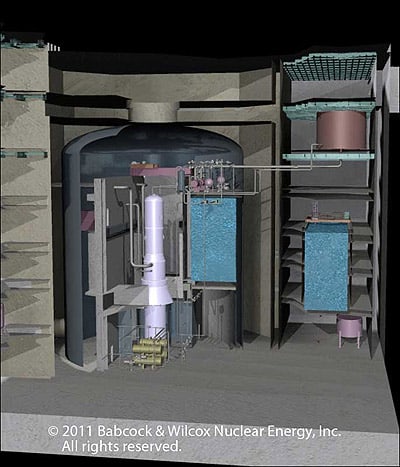
Like the NuScale Power Module, the CAREM is designed to achieve its full power using natural circulation in the primary coolant system. The flow of water through the nuclear heat source and through the steam generators is driven by temperature, density variation and gravity.
That feature has several attractive attributes. It means there are no pumps in the radioactive portion of the plant that require reliable power, cooling, controls or monitoring systems. If the system loses power, cooling flow through the reactor continues without any interruption.
Relying on natural circulation in all phases of reactor operation requires a trade-off; the maximum amount of heat that can be safely moved from the nuclear core to the steam generators is lower than it would be if the coolant was pushed through the core using pumps. If the designers chose to use pumps to push the coolant, it might be possible to increase the system power output by a factor of somewhere between 3 and 5.
Apparently, the CAREM designers have determined that the additional complexity is not justified for this version of their system. It is also possible that the decision was influenced by the desire to maintain the project’s domestic content as high as possible. Building sealed reactor coolant pumps is a tricky business with a lot of proprietary technology. There are not many capable suppliers in the world.
Recognizing that the CAREM is a first of a kind, the Argentine government decided in 2009 that the plant would be licensed as a prototype.
Following successful operation of the prototype, Argentina expects to build additional units and will seek sales in the export market. In addition to the traditional market of electric utilities, it is targeting markets where there is a concentration of industrial demand with customers might be as interested in purchasing steam as in purchasing electricity.
For example, Argentina and Saudi Arabia already have a nuclear cooperation agreement in place; the Kingdom would be an excellent location for reactors that provide the heat needed to desalinate water.
There is also a strong domestic reason for Argentina’s revitalization of its nuclear energy sector. Until fairly recently, the country was a net exporter of oil and natural gas. Now, though, it is importing both oil and gas. In 2013, its oil and gas trade deficit was $6.5 billion and all of those imports must be purchased using dollars instead of pesos. Argentina has proven domestic uranium resources that it is not currently exploiting.
Argentina has a large shale gas resource, but it apparently values the fuel diversity that uranium provides.
During the past summer, Argentina also experienced an electricity supply shortage that resulted in street demonstrations and protests. That shortage was mainly caused by a poor market design with low incentives for infrastructure investment. However, if there had been additional gas fired electricity supply capacity, it would have simply increased the fossil fuel import bill.


Good to see news for things happening in South America. At least from my limited perspective news media gives the whole South American continent short shrift.
Here’s something I spotted some time ago about a project in Chile:
http://www.thoriumpowercanada.com/technology/the-projects/
Its a interesting development. A very late one but a good idea probably for them. If the economic situation worsens I hope populist political forces do not derail the project. Hopefully (and it seems) they have stabilized their currency.
Electricity issues/outages seem to be something of a harbinger of doom it seems when comes to a area’s financial health. Not just for nations possibly either. Take Detroit (please):
Power outages closing DPS schools more often this year
During the 2012-13 school year, schools across the district missed 39 days because of power outages. So far this school year, 50 schools have missed 130 days ( http://www.freep.com/article/20140211/NEWS01/302110029/ )
They blame the failures on infrastructure issues mainly. DTE gets its power from 11 mostly coal plants and one NPP. “Environmental” groups have, of course, with the aid of the NRC’s snails pace on new projects, blocked expansion of the NPP.
Look at this questionnaire from the Michigan safe fish eating guide:
This quiz will help you find the best way for you to choose your fish.
Read each sentence and mark ‘T’ for true or ‘F’ for false.
I only eat fish caught in Michigan a
few times each year.
I’m 15 years old or older.
I DON’T plan on having children in the next several years.
I DON’T have health problems, like cancer or diabetes.
I DON’T eat fish from a lake or river that has posted signs with
“Do Not Eat” guidelines from MDCH.
If ONE or MORE are FALSE : You might be at higher risk. ( http://www.michigan.gov/documents/family_fish_166020_7.pdf )
Thats not a joke. It would be funny if it wasn’t so sad. I dont see how anyone there could attack nuclear with a straight face considering water quality there. I mean come on.
“When the mercury is falling” has more than one meaning in Michigan, I’m sad to say.
“I DON’T plan on having children in the next several years.”
“I only eat fish caught in Michigan a few times each year.”
I love those two. So soothing and comforting.
Mercury can be lessened relatively easily at coal plants with Activated Carbon Injection (ACI). Strangely enough the older coal plants that are to be shut down may have carbon carry over and meet mercury emission standards.
The SO2 and SO3 elimination are the bigger money.
The CO2 – well it ain’t gonna happen.
I believe other plants like paper mills also release mercury.
On the “Mother Nature News Network” (Now stop, I know!):
How do we plan for a future with more blackouts? ( http://www.mnn.com/earth-matters/energy/stories/how-do-we-plan-for-a-future-with-more-blackouts )
” The pressing urgency of climate change means that we have no choice but to massively ramp up the production of clean energy. Alongside that effort, investing in sophisticated technology for both better energy storage and distribution would seem like a no-brainer. And conservation and efficiency should be priorities for developed and emerging economies alike.”
It sounds like a pre-apology for the coming disasters related to “unreliables.”
South America is collectively going to hell lately it seems. Venezuela, after a few major blackouts last year and intermittent rolling blackouts as policy since 2010 at least, has again announced rolling blackouts and water rationing (low hydro output).
The economic situation is dismal. The obligatory blaming and expelling of US diplomats has also just occurred.
Chavez called off plans for Russian assistance in nuclear power in 2011 after fuku.
Venezuela remains a oil exporter but there are issues there such as a lack of investment in production infrastructure and the use of profits there to prop up other aspects of a failing state. With Chavez gone (along with his charismatic style) people are likely not as interested in doing without to advance state goals. Nothing seems to be moving to really fix supply issues and protests have been largely baned.
Throughout the continuing electric crisis, for years now, the Venezuelan government has blamed its citizen’s excessive consumption and internal as well as foreign sabotaging elements. They were on a renewable kick for a while up till recently and in the early 2000’s vastly extended hydro resources. Hydro however, as we are learning in California is also intermittent.
Its looking to get very ugly. Rather quickly possibly too.
@John Tucker
I would call hydropower “weather dependent” rather than intermittent. Of course, to a certain degree, all power supplies have a certain amount of weather dependence.
I read somewhere the capacity factor of hydro is around 50 percent. Perhaps “intermittent at lower frequency” ?
You know Rod it just dawned on me how useful SMR’s could be in some situations. If we had a few in reserve now for emergencies we could score a major diplomatic coup loaning a few now fixed or barges or whatever. For electricity and clean water in emergencies. Not to mention probably save more than a few lives.
I had thought of them more as fixed and resilient clean energy sources for out of reach high population density and disaster prone regions but they are also like city scale portable generators in a way that are not constrained by fuel logistics.
It is a shame and probably a disaster the US SMR projects are not further along. Even to use here to plop down in regions where fuel prices are being driven up to problematic levels by a mix of weather and insufficient supply. You could place them exactly where the electric infrastructure is already sufficient to support them.
I think the anti nukes have really screwed this country and the world over.
With hydro you have an essentially fixed amount of energy recharge available, and you can expend it slowly at high capacity factor or quickly at low capacity factor.
I’ve been saying for the last eight years that the anti-nuclear “environmentalists” caused climate change.
If the USA had continued building ten nuclear reactors a year from 1980 until the present, all of our electricity would now be nuclear or hydro, with, perhaps, some gas left in for load balancing.
That would be a 28% reduction in the USA’s current carbon emissions. But not just a reduction today. It would mean that over the last forty years, less total carbon would have been emitted during all of those years.
The sad thing is that not only will they never admit that they were wrong; they will never understand that they were wrong.
USS Enterprise had eight “SMRs” (by that capacity metric), already on a barge.
You’re right – we’re scrapping the ultimate disaster relief platform.
No way I’d build new for that purpose while we are throwing out time tested reactors on the same scale.
With not much use of a hangar bay, there’s room to add larger generators and a feedwater heating cycle. This would make quite a bit of electricity available on a platform with enough structural steel to support High Voltage transmission towers.
Scrap yard – here she comes!
@Rod : While hydropower is something I quite like, it is weather dependent. Almost all countries that have a high hydro dependency have some good hydro year, and then bad hydro years. So they also have fossil capacity to use as back up for the bad years.
This is the case with Portugal, Austria, Brazil.
As Engineer-Poet mentioned the big advantage of lake hydro is that you can modulate production without changing what you’re yearly production volume will be.
However they are also constraints on that,. Once the lake is full, you must produce, and when the dry season is in front of you, you must keep some water to be able to get through it without emptying it fully. And there might be environmental regulation that sets a minimum level of water to release to the river down the damn.
@Rod : But hydro has indeed a strong weather dependency.
This means that many high hydro countries have good and bad years, so need some backup fossil capacity that they keep for the bad years.
This is the case of Portugal, Austria, Brazil.