
Wild Day of Trading For a Company Reporting a Nuclear Plant Development Step Forward
When you read this, repeat this mantra to yourself – “no one wants to invest in nuclear energy projects”. At least, that is what people like Amory Lovins and Peter Bradford want you to believe.
I know that one day of stock trading for a “penny stock” means very little in the big scheme of things, but I cannot help pointing out something that many of you probably missed yesterday. There is a tiny company called Alternative Energy Holdings, Inc (AEHI) based in Idaho that has been working for several years to lay the groundwork for developing a nuclear power plant project in Payette County Idaho. Dan Yurman at Idaho Samizdat has written a number of articles about AEHI’s effort, many of which look at the company and its pronouncements with a deeply skeptical view.
Though I fully recognize the difficulty of what the company is trying to do, I also have a soft spot in my heart for entrepreneurs who are operating at the bleeding edge – or even in front of the bleeding edge. Remember, I am a guy who formed a company to try to design and build small modular reactors in September of 1993. It would be difficult to count how many people over the years – including my lovely wife, my loyal mom, and a former boss or two – thought I was absolutely nuts. (They were not completely wrong, mind you. I did end up going back to my old job in 1999 after putting Adams Atomic Engines, Inc. to sleep.)
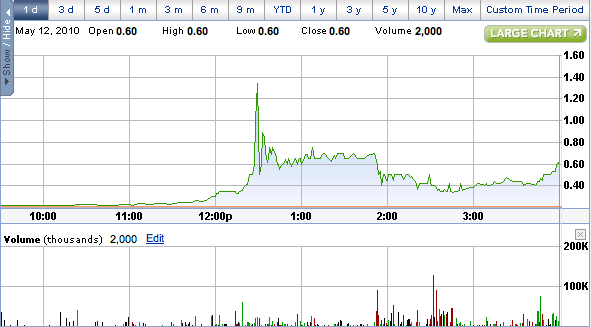
Anyway, back to AEHI. On May 11, 2010, the company issued a press release describing the Payette County Idaho’s Board of Commissioners unanimous vote to approve a change to the county’s comprehensive plan that would allow a nuclear energy facility – and no other industrial use – on a 5,000 acre plot controlled by the company. Here is a graph of the market’s reaction to that news on May 12, 2010. Note the closing price compared to the opening price – $0.60 versus $0.20.
Of course, it is likely to fall again, but what a fun ride.
Disclosure: AEHI makes up a small portion of my personal portfolio.

Rod, your problem was simple, you were a far better prophet than a business man. You just had a prophetic business that was 20 years ahead of its time.
I don’t rain on AEHI’s parade for arbitrary or personal reasons. The firm is a merchant play which means it will depend entirely on investor confidence in its project. On one hand AEHI has worked to boost confidence in its stock by registering with the SEC and moving from Pink Sheets to OTC. On the other, most of the investment in the firm still comes from executives and board members. Until there is a broader base of investors, and a credible investment bank, it is unlikely that the firm will ever build a reactor in Idaho or anywhere else. Profits from the rise in stock price from the land use decision in Idaho will accrue to the stockholders but that’s all.
Rod –
It was a great day for AEHI……not bad for me either. I was sitting on 4000 shares I bought for .10 each – sold 1000 of them @ 1.00. and Dan, yes, if the stock dips, I’ll buy ’em back again.
I believe the reason it is so difficult for companies to obtain capital for nuclear investments is the long payback period of nuclear. Majority of the cost is up front and the benefit is in the future revenues, which, in terms of IRR and ROI, is perfectly fine. However, Wall Street is all about the get rich quick mentality – they want to recognize immediate returns with no focus on long term portfolio growth. Nuclear energy is a great, stable, long term investment that will continue to yield predictable, sustainable returns over the life of operation. But like I said, Wall Street isn’t into that anymore; they’d rather precipitate the collapse of an economy for the sake of fast gains rather than patiently watch their investments grow at a stable rate.
In order to lower cost of capital a few things need to happen: a loan guaranteed by the government should have a substantially lower interest rate than the nuclear loans of times past (I’ve seen figures that put the average at 17% – not sure how reliable that is though), and there needs to be a paradigm shift in the financial industry whereby we get back to recognizing the value of projects that are capitally-intensive with future cash flow benefits. Pie in the sky, I know, but it will go a really long way to driving down the total cost of new nuclear construction since financing costs alone can represent up to 50% of the total project cost.
@Rod — AAE isn’t asleep, it’s in suspended animation. As to your business experience, I am reminded of this famous quote by Pres. Teddy Roosevelt:
http://en.wikipedia.org/wiki/The_Man_in_the_Arena
Good ideas that are ahead of their time have a way of being “rediscovered”. Only time will tell if AAE is one of them.