Rod Adams is Managing Partner of Nucleation Capital, a venture fund that invests in advanced nuclear, which provides affordable access to this clean energy sector to pronuclear and impact investors. Rod, a former submarine Engineer Officer and founder of Adams Atomic Engines, Inc., which was one of the earliest advanced nuclear ventures, is an atomic energy expert with small nuclear plant operating and design experience. He has engaged in technical, strategic, political, historic and financial analysis of the nuclear industry, its technology, regulation, and policies for several decades through Atomic Insights, both as its primary blogger and as host of The Atomic Show Podcast. Please click here to subscribe to the Atomic Show RSS feed. To join Rod's pronuclear network and receive his occasional newsletter, click here.

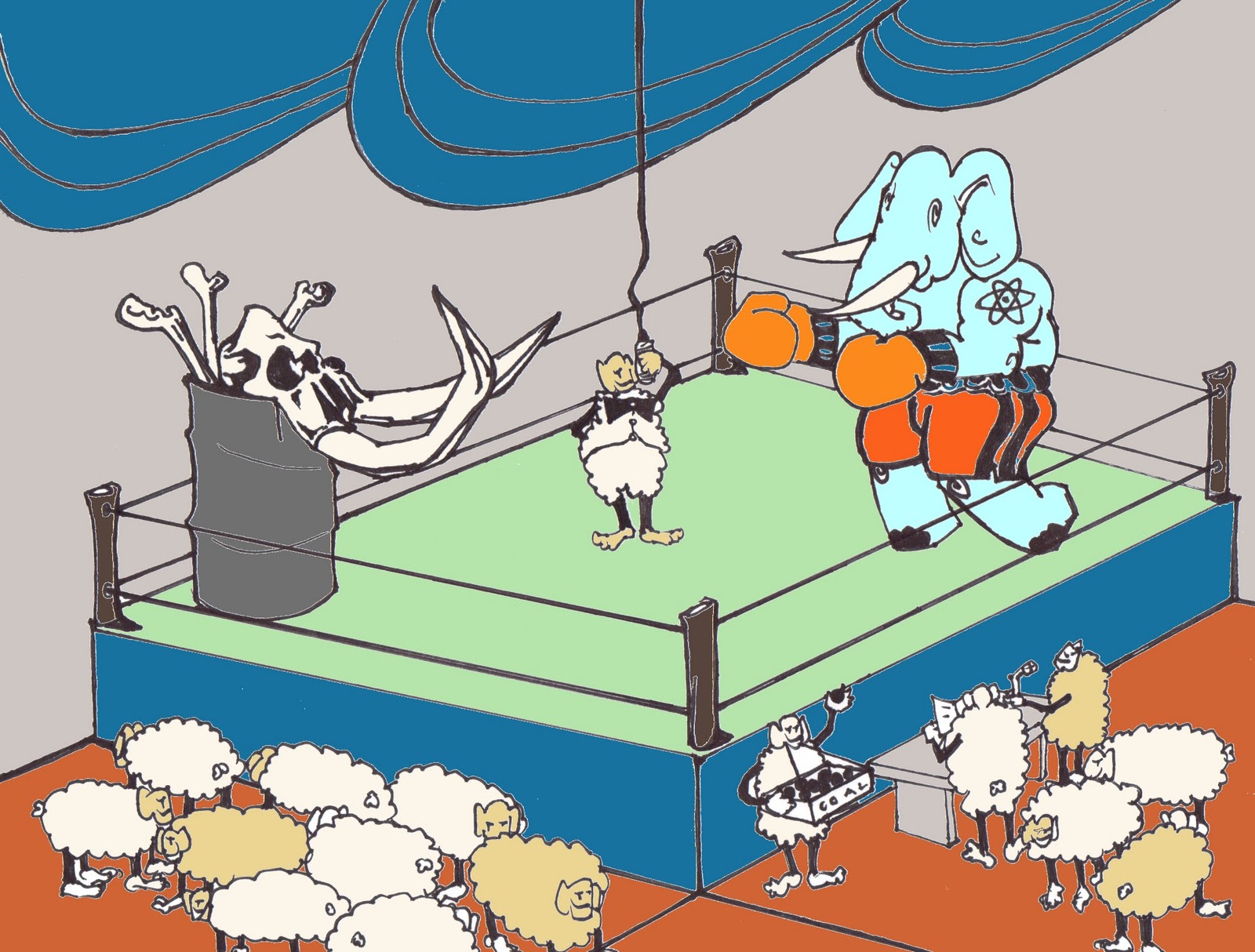


The perception of the editorial artist is conveyed. However, the view is superficial and lacks depth perception about the issues. First the consumers are not sheep and the only Elephant in the room dead or alive is the one aboard the Russian Submarine Sarov. Soon the Kazan attack sub will be fitted with even larger Elephants whilst the Us congress debates whether Elephants are real or not and how Elephants effect the vote in November.
Hydrocarbon fuels are valued in dollars whilst Atomic Elephants may simpliy smother Congress with their bulk.
Just wanted to share this response to another critic from the PopAtomic page (in short, he stated that the elephant was a symbol of the Republican party and that it’s not nice to call people sheep) because I think it is also a good counter argument to the above comment that the image is somehow “superficial”:
“Our cartoonist has developed a personal set of symbolic ideas through a series of cartoons, beginning with the idea of the
I’m sorrry Suzy, but I’m not too keen on this one, and your explanation only reinforces my perception. A cartoon image needs to be obvious in its meaning. If it needs an extended explanation to get to that meaning, then it has failed in its intent. It’s no good working with “a personal set of symbolic ideas” unless you have a wider audience which has already been made familiar with those ideas. We don’t have the luxury of signalling people in obscure code. We need our message to be obvious and accessable.
Another cartoon idea: Imagine someone who is very very thirsty walking into a shop to buy a drink. He has these choices:
Fossil fuels = liquor (coal = whisky 80% carbon, natural gas = beer)
Renewables = Snake oil
Nuclear = an energy drink bursting with energy, or a crystal clear (zero carbon) mineral water
No dude, no! You’ll have people thinking pro-nukes are a bunch of wowsers.
So, to respond to the critiques of Finrod and Michael R. Himes, one would need to create an image which is obvious, but not superficial?
http://www.rickwalton.com/folktale/50fabl46.htm
Obvious does not need to equate with superficial. Things can be obvious and yet contain initially unglimpsed depth.
Thank you Kelly! I agree with the sentiment of the story.
PopAtomic is an autonomous voice in the dialogue about energy, and that gives us a unique perceptive and value. Although our primary goal is support nuclear energy through the arts, we also have the right and duty to be critical, and to look at the complex social issues that the science world often ignores. Otherwise, we would not be serving our audience, or meeting our goals as a non-profit organization. We are much more than just an advocacy group.
@Finrod- Almost every successful cartoon series ever created has been based on “a personal set of symbolic ideas.” And almost every political cartoon is accompanied by a full length article, or some kind of text to inform the viewer of the artist’s persp
There is nothing invalid about the image just because it doesn’t simply praise nuclear energy, or because it deals with complex social issues. Political cartoons often evoke varied responses and interpretations- that is part of their purpose- controversy. And by that measure this cartoon has been wildly successful.
Sometimes I wonder if pro-nukes get their undies tied into too tight of a bunch. The “elephant is a symbol of the Republican Party” — oh no, we can’t have that! Never mind that, as a group, they are more pro-nuke than the “Donkeys” (or is that “jackasses”?). So the symbol that evinces such loathing from you is the group that actually supports your goal – to a larger degree than their political adversaries. Go figure.
Could the elephant reflect – strength, dependability, long-life span, durable, etc.?
Don’t forget, Doc, that there “jackass” got quite a kick! And it comes from behind, too, just when you’re least expecting it…
As for the cartoon, I agree with your point especially since it’s a live elephant versus a bunch of elephant bones in a barrel. So there are elephants on both sides. Fair enough. (If it was a fossil donkey in the barrel, then I’d be concerned.)