
Nucleation Capital’s Earth Day in Atherton
Nuclear energy has been making more frequent appearances at Earth Day events around the country. Groups like Generation Atomic, Mothers for Nuclear, Climate Coalition and Young Generation in Nuclear have been actively attending Earth Day events for a number of years.
On Saturday, April 23, Nucleation Capital participated in the Earth Day celebration hosted by the Town of Atherton, CA. The event, held in Holbrook-Palmer Park, attracted an estimated 600-800 community members in addition to some 150-200 people manning the 32 exhibitor booths, an electric vehicle and an e-Bike showcase, a special Kid “Bug” Zone, an art exhibit and a whole speaker series, which had experts from Stanford University, SFO and elected officials presenting.
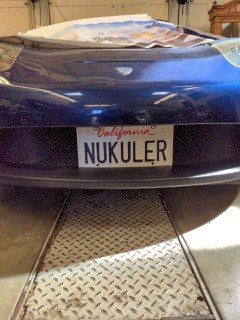
In past years, Atherton has educated its commuity about the critical role of nuclear power in providing clean energy with Earth Day screenings of films like Pandora’s Promise and The New Fire. This year, the town actively sought out someone to talk about nuclear and invited Nucleation Capital to participate. Dozens of attendees stopped by the nuclear energy booth hosted by Nucleation Capital and chatted with one or more of the seven folks recruited to help man the booth. Some of them were probably attracted by this Nucleation advisor’s early vintage, midnight blue Tesla Roadster, with its attention-getting license plate.
Aside: Readers, especially younger ones, might not recognize the allusion implied in the license plate spelling. I’ll let commenters provide their guesses for reasons why someone might choose the word “Nukuler” for their prestige plate. End Aside
In the heart of Silicon Valley, the reception of attendees towards nuclear was refreshingly positive. Of everyone who engaged in conversation, only three people expressed serious doubts about nuclear energy. The rest were open to hearing about the need for nuclear and advances in the technology that make nuclear suitable for 21st century clean grids.
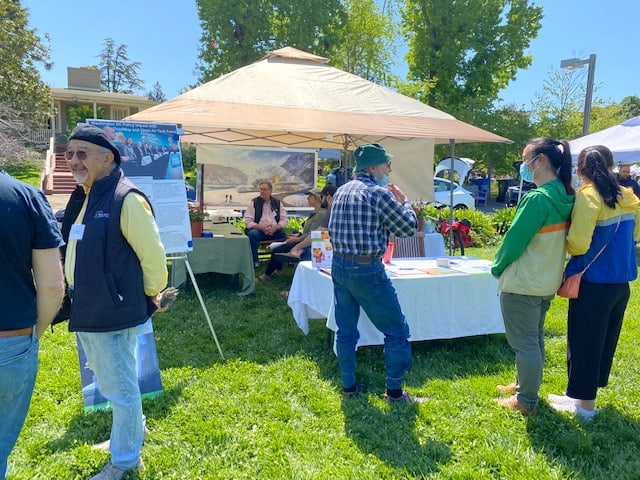
Our tabling team consisted of Nucleation Capital members, Valerie Gardner and Jonathan Tiemann, an expert advisor, Ross Koningstein, several local fund investors and Liz Muller, the CEO of Deep Isolation, Nucleation’s current syndicate offering and a Q1 fund investment. We really enjoyed the opportunity to talk with people about the roles that nuclear energy can play in the effort to transition more smoothly from hydrocarbons to clean energy sources. And, best of all, when people asked “what about the waste?” the answer was, “Talk to Liz!” Liz’s Deep Isolation team is developing the world’s first commercial solution to deep, geologic nuclear waste storage and we showcased The Deep Isolation Story video inside our booth.
It was very exciting to have one of the world’s leading experts with us and available to discuss the prospects of solving the nuclear waste “problem” with an inexpensive and permanent solution that is embraced by nuclear communities. We also addressed the speed by which the next generation of smaller, more modular plants could be built through pre-fabrication and mass production and how they could provide both electricity and high-temperature heat for industrial processes, so as to decarbonize industrial sectors that need heat not produced by renewables. People recognized that these are critical areas to address.

It almost goes without saying, but we also talked about the opportunities for investing in advanced nuclear energy ventures. Silicon Valley is ground zero for people receptive to providing risk capital for emerging technologies. We made the case that advanced nuclear ventures have a role to play and that private equity investment is an important ingredient for the successful development and deployment of advanced nuclear systems that will eventually supplant what are now record levels of fossil fuels being burned.
A significant portion of Atherton residents have the resources to help this important technology soar and most did not realize that there are now a few ways that investors can access these exciting areas of nuclear innovation through Nucleation’s offerings.
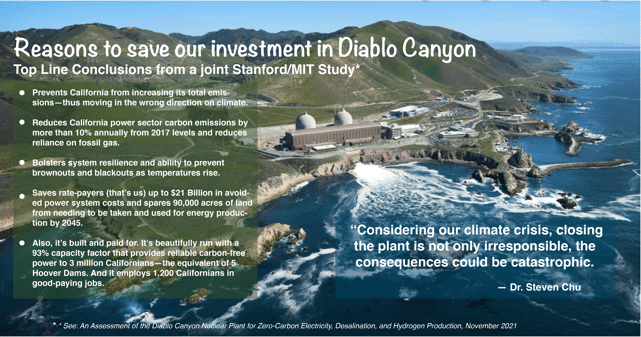
Of course, it being California, Saving the Diablo Canyon nuclear power plant was also a subject of discussion during the day. We are deeply committed to doing whatever we can to help keep that valuable clean electricity generator operating for a full lifetime of 60-80 or more years. In addition to taking the opportunity to talk about the importance of extending the plant’s operating life beyond the currently planned closure, we collected dozens of signatures for the Climate Coalition’s letter to Governor Newsom to save the plant.
Earth Day in Atherton proved to be a fun and effective way for us to talk about the role of nuclear energy as a climate solution and broaden public awareness that it is a happening technology sector that is actively developing a broad array of innovative future solutions.
If you participated in an Earth Day event and took the opportunity to talk about nuclear energy, please share your story.


A fear precious to the antinuclear community is that reactors are not compatible with earthquakes. However, reactor plants are designed to survive such shocks, encased in and on masses of reinforced concrete. Yet they continue to predict that a Fukushima-sized earthquake would break a nuclear reactor open and pulverise its fearsome contents into the sky and over the city. However that proposition was thoroughly tested by the 2011 Tohoku earthquake of magnitude 9.1. Every single one of Japan’s nuclear reactors survived the earthquake intact. Seeing as the magnitude was higher than the highest expected by the designers, their margin of safety was solidly proven.
Sure, cracks developed in basements in at least one reactor pad, letting groundwater in and complicating the response to the separate disaster of the tsunami. But that is not sufficient reason to avoid building earthquake-resistant concrete in California, not even if it contains a nuclear reactor.