
Tamping down the spread of NC Warn sponsored misinformation regarding the comparison of solar and nuclear costs
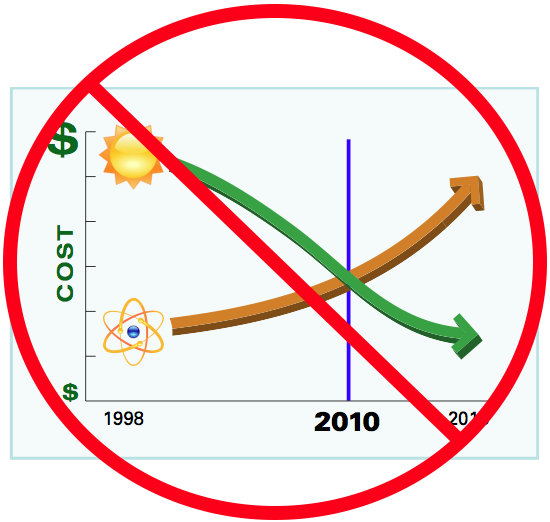
On July 8, 2010, an activist group named NC Warn that is specifically organized to fight reliable nuclear energy and promote unreliable, weather dependent wind and solar energy published a press release announcing to the world that they had commissioned a paper proving that solar generated electricity had become cheaper than electricity from new nuclear power plants.
As I noted in a post on July 28, 2010, that paper should be read critically and completely to find out that the solar price used was only available after including an assumption of a 25 year, low interest loan AND the effects of having taxpayers pay 65% of the initial capital costs of installing the rooftop solar system. I also pointed out that the nuclear electricity cost used in the study was not based on extensive research, but on the work of a single activist/advocate who loudly touts the fact that he has a PhD from Yale and quietly buries the fact that the PhD was awarded in Sociology based on research discussing the political turmoil in Egypt during the time of Gamal Nasser.
Unfortunately, not every person who reviewed the NC Warn sponsored paper, read their press release or found derivative work on the web used quite as much skepticism. On July 26, 2010, Diane S. Powers, while writing a Special Report: Energy and the Environment for the New York Times titled Nuclear Loses Cost Advantage seemed to accept the conclusions of the Blackburn and Cunningham paper without any fact checking.
She might not have even read the whole paper or understood how the paper authors manipulated the entering assumptions to produce the desired conclusion. On August 3, 2010, The New York Times editorial staff appended a note to the Powers article, pointing out that the author should have mentioned that the paper she used as a primary source was prepared for an advocacy group. The editors also noted that Powers failed to take into account other studies that have reached significantly different conclusions about nuclear costs and failed to quote any authorities who have elaborated on different ways to analyze energy cost projections.
In the period between the July 26th New York Times article publication and the August 3rd editor’s note, Osha Davidson published another uncritical summation of the NC Warn paper on The Energy Collective titled Study: Solar Power is Cheaper than Nuclear. Despite a number of very critical comments, Osha’s article on The Energy Collective has been read more than 30,000 times; it remains available in its uncorrected form; and it has been used as a reference source for several other articles. The ones I have found so far include one published by the Miami Herald on August 8, 2010 titled Solar power now cheaper than nuclear and one on the National Review dated August 11, 2010 and titled Soar Cheaper than Nuclear?.
In my efforts to help readers understand the the context of The Energy Collective’s uncorrected publication of the false claim that solar is “cheaper” than nuclear, I posted the following comment on the Miami Herald article:
It should be understood that The Energy Collective is a blog aggregator, not an edited news source. The authors at TEC are responsible for their own work, so the credibility assigned to the piece about the cost of solar electricity versus nuclear electricity should be no more and no less than would be assigned to a piece by the same author and published on his own blog.
With regard to this specific article, the author based his work on a paper funded – quite openly, I might add – by a group that is openly opposed to the use of nuclear energy and organized to encourage the use of alternative energy sources. Here is a quote from NC Warn’s own mission statement: “NC WARN is a member-based nonprofit tackling the accelerating crisis posed by climate change – along with the various risks of nuclear power – by watch-dogging utility practices and working for a swift North Carolina transition to energy efficiency and clean power generation.”
The paper was written by a retired economics professor and a student who is working on his Masters in Environmental Management. Neither one has any experience or qualifications that would lend credence to their analysis of the cost of generating reliable electricity. The NY Times editors put a cautionary note on their version of the article. Readers would be advise to do the same on this one.
(Note: I corrected this comment from the original posted on the Miami Herald site to properly reflect the fact that Davidson’s article did not mention the NY Times piece.)
My self-appointed task of stomping out the spreading misinformation has not ended. Yesterday, an Atomic Insights reader sent me a link to an article on Solve Climate that was published on August 10, 2010 titled Study: Solar Power Officially Cheaper Than Nuclear in North Carolina. That article was actually better than I expected based on the title, because the author included some additional research, opinions and information that allowed readers who used their critical thinking skills to reach a reasonable conclusion that disagreed with the headline of the article. Here is the somewhat tongue in cheek comment that I left on Solve Climate:
I am not sure if the headline for this article was chosen to attract readers instead of accurately portraying the information that readers should take away from the article, but that is what appears to have happened. I must congratulate you on putting together a fairly balanced piece that lays out some of the real complexities associated with predicting the price of power from various energy sources while comparing the VALUE of the power from those energy sources.
Perhaps I am only prejudiced because of my 29 years of energy production experience and education to be in favor of nuclear generated electricity that can be made available whenever and wherever it is needed. Perhaps it is unfair for me to use the fact that 800 billion kilowatt hours of nuclear generated electricity is profitably sold into the US grid every year for an average wholesale PRICE of less than 7 cents per kilowatt hour without any financial subsidies to totally discount the conclusions of a retired economics professor and a masters degree candidate in Environmental Management.
That pair of highly “qualified” researchers, while working for a tax exempt activist group specifically organized to fight nuclear energy AND to promote wind and solar energy have somehow managed to promote a paper purporting to “prove” that solar electricity available only when the sun is shining and priced at 15.9 cents per kilowatt hour AFTER including a 65% taxpayer provided subsidy is OFFICIALLY cheaper than nuclear.
That is some amazingly crea
tive work. I have to take my hat off to them for their ability to get attention while being unconstrained by integrity or reality.
You made an interesting point when you noted that nuclear plants are not suitable for being cycled to enable the deployment of expensive, unreliable and intermittent sources. Perhaps that is why Chinese solar panel manufacturers are selling 90% of their products to other countries while Chinese nuclear companies are almost completely focused on providing equipment to the domestic market. I recognize that Chinese leaders are savvy enough to keep the best stuff for themselves while making lots of money from taxpayer subsidized renewable energy promotion schemes in other countries.
I just wish that the leaders in my country had studied more math, science and engineering instead of studying to become lawyers and snake oil salesmen.
If your readers want another view of the paper sponsored by NC Warn and written by two people who only happen to have some association with Duke University they can find it at:
If you want to read a balanced report on the NC Warn paper written by a journalist with a proper amount of skepticism and additional research, I recommend David Ranii’s July 8, 2010 blog titled Solar power is cheaper than nuclear, report says. David properly recognizes that it was “news” that a report was released claiming that solar is cheaper than nuclear – mainly because it seems so unreal. He quotes liberally from the people who are charged with the legal responsibility to provide reliable power to make it clear that they have the following opinion of the study:
Duke Energy, in a filing with the commission, called Blackburn’s estimates “so flawed as to be completely unreliable.”
Progress Energy spokesman Mike Hughes said that the utility doesn’t dispute that solar costs are declining, but said that comparing the cost to nuclear is comparing apples to oranges.
“One produces electricity a small part of the time and the other continuously,” he said in an e-mail message.
“Importantly, actual experience in North Carolina to date indicates that solar…plants are producing electricity about 16 percent of the time,” he noted. “We expect that number to grow, but our customers do not only use electricity when the sun shines, so we have to invest in many technologies, including solar, biofuels and new nuclear energy.”

This report is not very long. I’m unfortunately not surprised, however, that many in the media and several bloggers can’t read the report and have alarms going off in their heads that what they are reading is nonsense.
The difference between the Miami Herald‘s article and the National Review‘s article could not be more stark. The Miami Herald parrots the reports conclusion; the National Review trashes it.
Brian – the NRO post does question the report, but still accepts its assertion that with subsidies solar might be cheaper than nuclear. My point is that even after the subsidies, the cost published by the NC Warn sponsored report still results in a price that is far higher than what nuclear plants already achieve at a very substantial profit.
This is not a political argument – it is simply the fact that the average cost of electricity generated in operating nuclear plants using ancient, 1960s vintage technology, is only a small fraction of the subsidized cost of solar electricity using the most modern panels available on the market today.
Rod – Hmm … perhaps you didn’t read the National Review article very carefully. I don’t see where it accepts the assertion of the report. Here’s what I read:
“there is no contest that nuclear power gives us the best bang for our buck. Rain or shine, we can split atoms.”
and
“So, before we throw photovoltaic panels a ticker-tape parade, let’s be mindful of the limitations of intermittent renewables that are “competitive” simply because U.S. taxpayers are forced to make them so.”
Perhaps you missed the quotation marks used to denote an ironic use of a word. I take this to mean that the author doesn’t think that solar is competitive even with the generous subsidies.
By the way, comparing the costs of running a fully amortized nuclear power plant to the cost of brand new solar panels is not comparing apples to apples.
Solar kWh prices could be compared to nuclear kWh prices if we had a battery-powered economy. If every house, and every factory had a giant battery installed, similar to a heating oil tank, or every appliance had it’s own battery (battery powered washers, battery powered TVs, battery powered ACs) then an amount of kWhs supplied by an intermittent source would be just as valuable as kWhs from a reliable source.
But since virtually all electricity consumers – with few exceptions like cell phones, electric cars – want “on demand” electricity, the comparison is deceptive. I’ve recently made an illustration that is trying to make that point easy to understand: http://www.facebook.com/photo.php?pid=4732971&l=93f7387f00&id=753382824
The NC Warn paper, and a lot of the reporting on it, remind me of some of the conclusions reached by Tom and Ray on Car Talk, which they freely admit are “unencumbered by the thought process.”
You *could* theoretically have air conditioners, washers, and TVs each with their own small engine or engine/generator combination unit. I have heard of diesel-powered air conditioning units (using a belt-drive), and Maytag once made a line of gas-engine powered washers. (They were popular before rural electrification. If you google “Maytag washer engine”, you’ll find a bunch of interesting videos of gas-powered washer engines of the rare hit-and-miss type.) But batteries are not gas tanks – I would hate to see a battery powered air conditioner, for instance. Even a forklift battery, say, 23kVA total at a 24 h rate of discharge, would only be able to power an air conditioner for a day (assuming the A/C was a 900 W load.) And forklift batteries weigh 1500 lbs (source as to batteries weight and density: Northern Arizona Wind and Sun).
Heating oil contains around 23k BTU/lb, or around 14800 Wh/kg. (source: WP, web) Lithium batteries have an energy density of somewhere around 300 Wh/kg (source: memory), or around 50 times less energy density. Plus, I would guess – but don’t know – that lithium batteries cost at least 50 times as much per lb as heating oil does. Of course, they’re reusable, and once volume production of the new lithium phosphate batteries starts in earnest, electric cars – at least for commuting – will become practical.
(For another comparison, according to WP, uranium has an energy density of 967,680,000 Wh/kg in a standard LWR in a once through fuel cycle.)
Batteries are great, when you don’t mind weight, volume, cost, and maintenance. For everything else, there’s your electric utility.
The problem is that antis dressed up non-factual opinion of activists, graduate students, and economics and law professors as news and some gullible reporters bought it. As was famously said by parties unknown, “If you can’t dazzle them with brilliance, baffle them with b***s***.” Reporters report the news, so non-technical people taking statements from “experts” at face value on complex topics like the technical and economic merits of various sources of electricity is to be expected unless we’re dealing with someone who specifically reports on energy. Still, the lack of checking the facts of statements by those experts opposed to nuclear energy with experts who support nuclear energy construction is not acceptable.
Perhaps some wishful thinking on the reporters’ parts was also involved. For instance, the apparent story may have agreed with the reporters’ reality-construct, and they were eager to affirm their reality-construct even if their reality-construct was not in phase with objective reality.
At least the Times was good enough to note the irregularities in the article after it was pointed out to them.
Still, I cannot help but note that the Times followed up their correction with another vigorous attack several days later on their op-ed page against that b