The New York Times published a story titled Certainties of 1970s Energy Crisis Have Fallen Away that caused me to fire up my keyboard to send a note back to the author. Following my personal mantra of “reduce, reuse, and recycle”, I thought I would share that note with you.
Ms. Galbraith:
Your article titled “Certainties of 1970s Energy Crisis Have Fallen Away” was interesting, but it contained an inaccurate and misleading sentence:
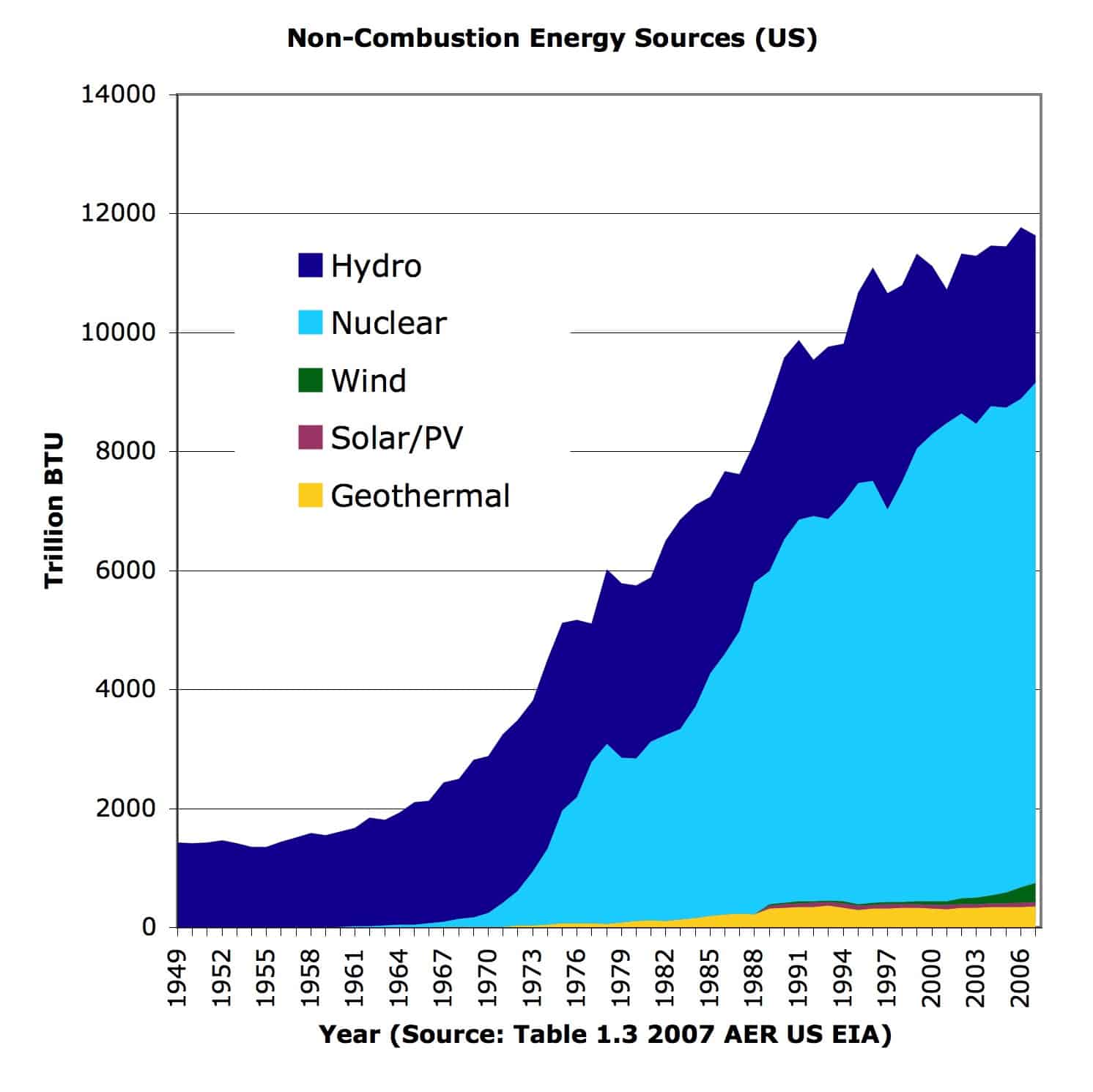
“The only alternative to succeed on a large scale, however, has been wind power, and most of that growth did not occur until the past decade.”
You mentioned how current events seem like deja vu for “Texans of a certain age.” I consider myself to “of a certain age”, though I am not from Texas. As a 51 year old grandfather, I came of age during the 1970s. The Arab Oil Embargo and the Iranian hostage crisis were two of the more influential events of my life; both illustrated the vulnerability of my cherished American way of life to events in distant lands. Our freedom and comfort are often dependent on fuel extracted and transported enormous distances.
After sharing the American experience of two very painful lessons about energy, I chose to enter a profession that offered a path towards independence. As a nuclear-trained submarine officer, I spent many months at sea without getting a single fuel delivery and without emitting a single molecule of SOX, NOX or CO2 – except during those rare times when we practiced using our emergency diesel engines. The US Navy no longer operates any oil powered aircraft carriers or submarines; all of them use nuclear energy instead.
In the commercial electric power business, nuclear energy, which produced no electricity in the US before 1957, grew to the point where it now produces about 806 billion kilowatt hours per year in America. That is more than 10 times as much electricity as windmills produce. It is also about 30% more electricity every year than the entire US power grid produced in 1959, the year I was born. It has helped to eliminate the use of about 1.5 million barrels of oil per day from the electric power market.
According to the BP annual energy outlook, nuclear power plants around the world produce the energy equivalent of 12 million barrels of oil per day. That output is equivalent to the contribution of Saudi Arabia PLUS Kuwait.
Though there have been many efforts to suppress this technology – many driven by people who make a lot of money by selling coal, oil and natural gas – nuclear energy has had a far more successful history of replacing fossil fuel in the energy market than any other alternative energy source.
It is poised to continue capturing a growing market share as more and more people realize that the events at Fukushima Daiichi, as scary as they have seemed, have resulted in very few actual injuries or illnesses.
Rod Adams
Publisher, Atomic Insights
Rod Adams
Rod Adams is Managing Partner of Nucleation Capital, a venture fund that invests in advanced nuclear, which provides affordable access to this clean energy sector to pronuclear and impact investors. Rod, a former submarine Engineer Officer and founder of Adams Atomic Engines, Inc., which was one of the earliest advanced nuclear ventures, is an atomic energy expert with small nuclear plant operating and design experience. He has engaged in technical, strategic, political, historic and financial analysis of the nuclear industry, its technology, regulation, and policies for several decades through Atomic Insights, both as its primary blogger and as host of The Atomic Show Podcast. Please click here to subscribe to the Atomic Show RSS feed. To join Rod's pronuclear network and receive his occasional newsletter, click here.
For more than forty years, the United States and the Soviet Union built nuclear weapons and aimed them at each other’s heartlands. The process of building those weapons was expensive in strict monetary terms and in terms of sacrificing investments in more productive enterprises. Now, however, the confrontational attitude between the two countries has been…
When Unit 4 blew up, it became a huge opportunity for those who wanted to point out the weaknesses of the Soviet system. It is impossible to separate the reaction to Chernobyl from the long-standing rivalry between the Communist and the Capitalist economic systems. The Chernobyl nuclear station was never viewed as just an electricity…
CBS TV 6, one of the television stations closest to the North Anna nuclear power station was allowed to take a tour to see the massive damage caused by one of the largest earthquakes that has ever occurred in the US east of the Mississippi River. Caution – the video you are about to see…
The six months since Fukushima has brought out a certain class of professional worriers who ignore history to fret about topics that have already been the source of concern for many years. In this particular case, the worriers want to assert that nuclear power plants are uniquely vulnerable to the effects of earthquakes, which are…
Proving the Principle provides some wonderful and inspiring stories about the days when the United States had a place where atomic tinkerers could explore new ideas and test those ideas with real reactors and real materials. It also provides some insights about the economically and politically motivated reasons that a place with those characteristics no…
I’m a progressive liberal who frequently listens to Democracy Now! That makes me a bit of an oddity because I am also fiercely pro-nuclear energy. It has numerous capabilities that should appeal to progressive thinkers; it is abundant, affordable, compact, reliable, and emission-free. Unfortunately, the catechism taught to hereditary or geographical liberals includes such talking…
This site uses a cookie for Google Analytics. Accept or decline — your choice.