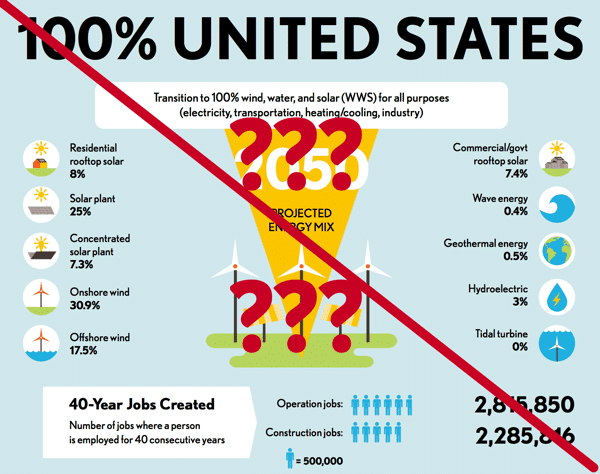

Ben Heard and Geoff Russell collaborated on a post for DecarboniseSA titled Green Nuclear Junk that takes careful aim at an antinuclear meme that is mostly based on a series of false assumptions that include a table of mortality figures made incorrect by dividing by 8.76 instead of multiplying by that same number.
With Ben’s permission, I have decided to publish another copy of his important article in hopes of increasing its exposure and generating a new series of comments. My goal is to add just a little more pressure on Jim Green — the national antinuclear campaigner for Friends of the Earth, Australia — to come clean and admit his mistakes. It would be even better if Green began to make amends for the environmental and economic damage caused by his antinuclear activism, but that is probably a futile hope.
Green Nuclear Junk
By Ben Heard and Geoff Russell
In their determination to attack nuclear power and those who support it, anti-nuclear activism has walked away from the scientific process. As a result, nearly the entire community of environmental organisations in Australia is currently standing behind figures that are completely mathematically incorrect. Will they correct these blatant errors and open their publications to expert external review? Or is correct maths and good science optional when you wear the colour green?
The great scientist Carl Sagan famously said that extraordinary claims need extraordinary evidence. So how is it that Jim Green, an anti-nuclear campaigner with no scientific journal publications, can accuse James Hansen, one of the most extraordinary scientists of the last 50 years, of junk science?
In Green’s recent article “James Hansen’s nuclear junk science” he does precisely what good scientists don’t do. He cherry picks data.
For those who came in late, Pushker Kharecha and James Hansen recently calculated, in the journal Environmental Science and Technology, that the historic deployment of nuclear power had likely prevented 1.84 million air-pollution related deaths, and by mid-century would prevent a further 420,000 – 7.04 million such deaths.
Read more »