
NCSE Food-Water-Energy Nexus – Day 1
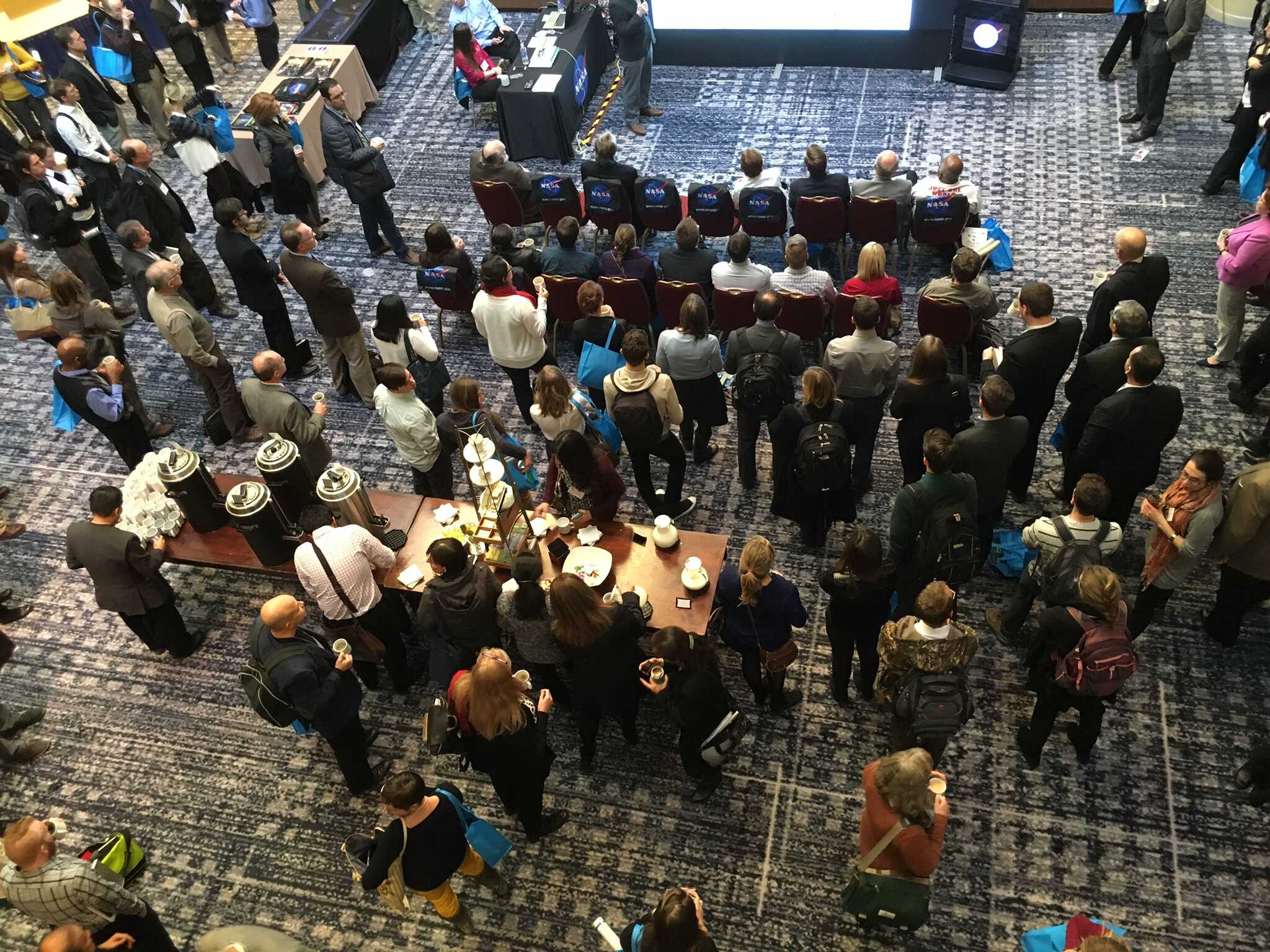
The National Council on Science and the Environment (NCSE) is holding its annual conference this week at the Hyatt-Regency National Airport hotel in Washington, DC. This year’s conference topic is the food-water-energy nexus; it is aimed at bringing together people who are deeply engaged in science, actions, and policy development to address one, two or all three of the issues.
The idea is to help more people see that the ways that we work to provide human society with adequate and reliable supplies of all three life enabling commodities are deeply interrelated. Solutions to challenges should be pursued with a holistic understanding of the ways that the solutions can affect each issue.
As just one of a myriad of examples, a hydro electric dam project to provide much needed electricity might require flooding valuable farmland that is supplying food.
As was reinforced during several of the talks or presentations yesterday, in most countries, there are separate, often siloed ministries or agencies with assigned responsibilities for one of the three commodities of interest. In developing nations those ministries are often constrained by a limited number of qualified supporting staff and decision makers.
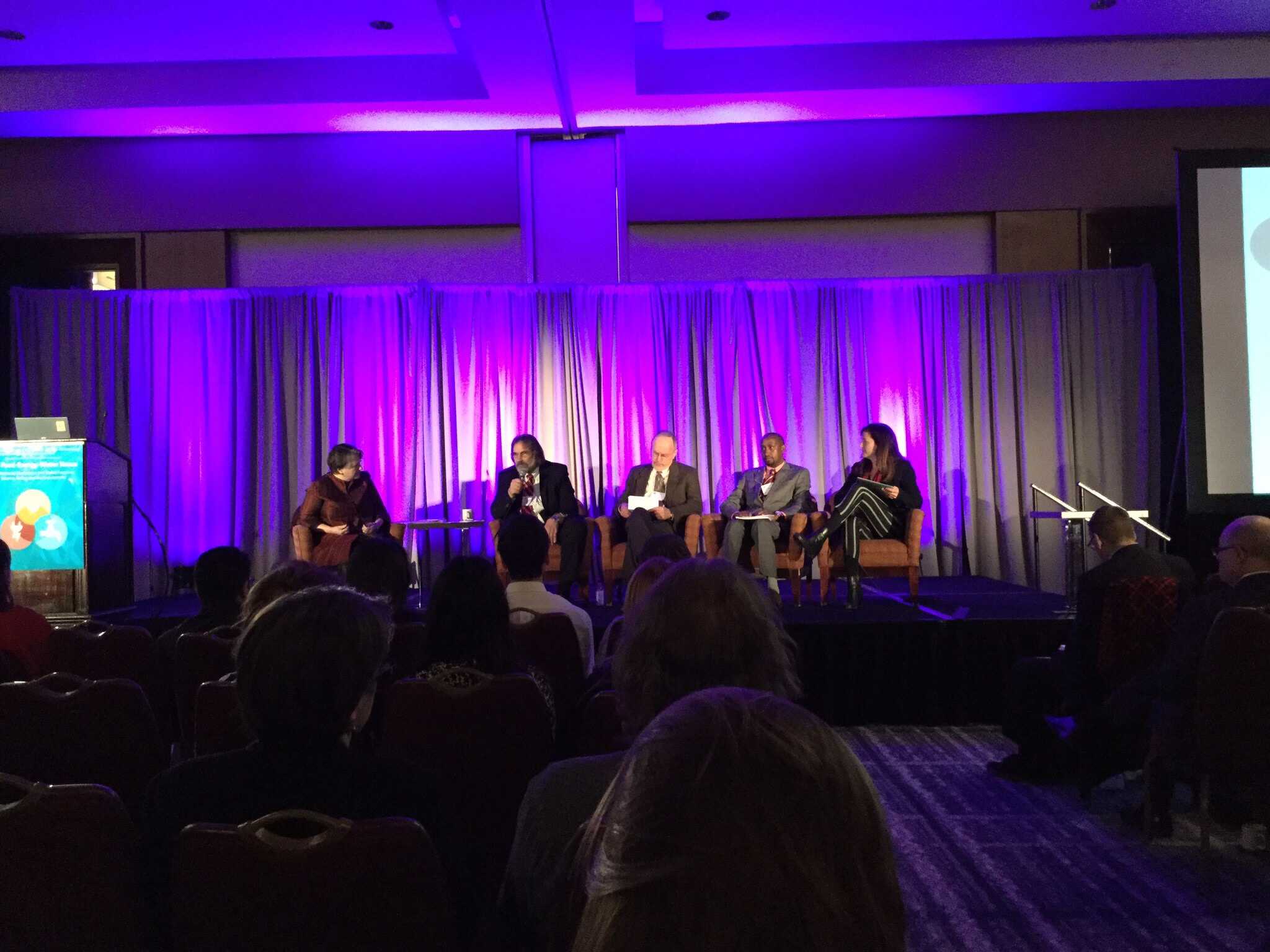
The challenges bein addressed at this event are often seen as wickedly difficult and requiring a great deal of dedication, creativity, product innovation, scientific advances, and political policy changes.
Nuclear energy is a powerful tool that can mitigate limitations in other technologies being used to address the challenges. It is almost completely missing from the formally published agenda. It’s not completely clear why that situation exists.
I’ve spoken to dozens of the people attending the conference. With one exception, they have been curious and open to learning more about how atomic energy can help them achieve their goals. It was encouraging to learn, for example, that the United Nations Foundation has a program for energy access whose people are tracking small reactor developments in anticipation that they might someday be available for deployment.
The moderators of both of the morning’s plenary session also indicated their openness to finding out more by selecting written questions that I submitted. The answers were reasonable and discussed both opportunities and concerns that are being addressed or have already been mostly solved. My sense is that there is plenty of room for nuclear professionals, especially those who are working on small power systems aimed at remote and developing areas, to engage and attract allies.
At last year’s NCSE conference, a group of primarily thorium molten salt reactor advocates set up a session, but it wasn’t well attended. I spoke at that session, but decided this year that it would be more productive to avoid the risk of isolation.
There are plenty of opportunities to talk to other nukes; this is a good conference for reaching out to people who share broader concerns. We agree about important topics like the need for energy security, clean power sources, power sources that can function without a continuous fuel supply infrastructure, and power sources that are capable of powering life enabling tools like refrigerators, diagnostic equipment, water pumps, and water treatment facilities.
I met some fascinating people. One was a student in her last semester at American University in an interdisciplinary program that combines political policy, economics and environmental engineering. Several were professors or administrators associated with land grant university agricultural research, both for improved food crops and biofuel development.
One was a young woman who grew up in Tehran and is now working on her PhD in engineering at Georgia Tech. It was a real learning experience to talk with her about her experiences and journey. Since she had attended the same undergraduate university as one of my daughters, we found a connection early in the conversation.
There was a wait for tables at lunch, so I invited another person who was obviously on her own to share my table. She was a children’s book author who also writes articles for National Geographic. We had a wonderful conversation about children, children’s books, and south Florida environmental abundance/challenges. She was the one person who declared her strong opposition to nuclear energy almost as soon as she saw my nametag with “Atomic Insights” prominently displayed.
We agreed to put that topic aside. By the end of the meal, however, she began asking questions about my work. We realized we knew many of the same people, even thought we did not necessarily see them with the same lens. She promised to introduce me to a friend of hers who, as she put it, thinks like I do.
During the evening reception, I met two students working on their M.Sc in environmental or climate change policy at Bard CEP (Center for Environmental Policy). We had a productive exchange with both of them asking probing questions and listening carefully to my answers. At the end, one of them said he had “some blog reading to do.” I hope he joins in the conversation here.
One of my longest, and potentially most fruitful conversations was with a professor at a small liberal arts college in Southern California. He’s been teaching for more than 30 years in a wide variety of courses on the boundary between biology and chemistry. He operates a rooftop solar system, no longer uses a clothes dryer, drives an electric car and is deeply interested in breeder reactors.
When I asked him how his family dries their clothes when the weather isn’t cooperating, his answer was interesting. Though he lives in a place where rain is an infrequent issue and it never gets as cold as it was in DC yesterday (windy with a high in the low 20s) he told me that they dry their clothes in the garage. That’s because he and his wife decided that the air in the LA basin, though much cleaner now than when they first moved there, doesn’t always help the clothes smell fresh.
I had a great conversation with a woman from the University of Michigan Graham Sustainability Institute about her efforts to match scientists and engineers who have developed useful solutions with policy and decision makers who could use those solutions if they knew they existed.
While we were conversing, we were joined by a writer from Scientific American who turned out to be a friend and longtime colleague of John Horgan, the SciAm writer who has invited me to appear with him on Bloggingheads a couple of times.
Two of my favorite sessions of the day both involved food and books. Daniel Barber, the Executive Chef at Blue Hill Farm and the author of The Third Plate: Field Notes from the Future of Food talked about his farm to table restaurant, his unashamed inclusion of meat in his diet and menus, the relationship between soil quality and food taste, the utility of learning to use more variety in cuts, seasonal vegetables, and even how foie gras can be a guilt-free delicacy during a limited season of the year if the geese are not force fed.
Simran Sethi talked about her recently published book titled Bread, Wine and Chocolate: The Slow Loss of the Food We Love and the five years worth of research invested in tracing origins of taste, plant diversity, challenges of relying on an ever shrinking number of commodity products, and the joy that can come from telling important stories in a way that engages readers or listeners.
I’m looking forward to more conversations and learning opportunities today.


Wonderful to hear, Rod, and thanks for the post. Talking about technology (what) obviously wasn’t working. Doing the jawboning, making connections and getting the feel of the group will pay many dividends. Maybe next year you could talk about ‘why’ and outline the possibilities of applying high power density energy systems in many many ways.
Keep those ears open.
Rod,
I remember back around 1980 when “OTEC” (Ocean Thermal Energy Conversion, I think) power plants were envisioned. They would use the temperature differential between warm surface water and cold water from the deep to generate electricity. A byproduct of the electrical generation was the nutrient rich water from the ocean’s depths. That water was used for aquaculture. What if the concept was modified: A floating nuclear power plant brings up coolant from the deep (and lots of it), thus providing nutrients for a fishery.
(to the tune of “Promises. Promises”…)
Nuclear lip service, glib and gushing and garbage.
That’s ALL that really comes out of all these types of energy and environmental conferences. Really, does nuclear EVER get any shovel-in-the-ground traction from them? Ever notice how gas and oil ads NEVER consider THEMSELVES as part of the “energy mix”, but rather wind and solar and tides (and once a blue moon nuclear) are part of THEIR “energy mix,” like raisins added to a gas/oil vanilla cake mix. Hate “mix.” You need any “mix” to make floating-city nuclear aircraft carriers go? I see a severe lack of commitment and a severer lack of spine getting nuclear up to speed, unlike China and Russia maybe India who don’t kowtow to shrieking fright groups. Yea, to admire China so…
I also have SEVERE reservations of the U.S. delving into floating nuclear plants. They are indeed ingenious and doable solutions but they come with one bad P.R. boomerang that’s ultra-fodder for anti-nukers: “See, nukes are SO dangerous that you have to park them on boats that can beat a hasty retreat over the horizon when trouble starts!” No joke, that’s how the public here will perceive floating nukes — also to the detriment of extending or even building new ground-based plants here. Look all ways before you leap!
James Greenidge
Queens NY
I’m with you on the “mix” gibberish. If you have something good that works, why “mix” it with anything? That only leads to dilution. The only time it seems to come up is in the discussion of nuclear energy, as if it’s some kind of sop to throw a little nuclear into the “mix”. If we’re going to mix anything, make the “mix” much more concentrated with things we know how to do, that are proven to work, and are beneficial to the environment and the economy. Can’t think of anything much better than nuclear by that reckoning.
As James says, none of the other competitors want to just be a part of the “mix”, they want the whole enchilada. Look at the latest version of the Vermont “plan”. They want 90% unreliables. They’ve said to h*ll with any “mix”, especially not nuclear in their “mix”.
“One of my longest, and potentially most fruitful conversations was with a professor at a small liberal arts college in Southern California. He’s been teaching for more than 30 years in a wide variety of courses on the boundary between biology and chemistry. He operates a rooftop solar system, no longer uses a clothes dryer, drives an electric car and is deeply interested in breeder reactors.”
Any chance you could put him in touch with me, Rod? If he’s on Twitter, I’d be eager to follow him (and I assume he’d want to follow me). Thanks, if yes, but no worries if you didn’t get his contact info and don’t run into him again.