
ExxonMobil, One of the Biggest Owners of the Energy Supply Casino, Explains Its Big Bets on Natural Gas
I have a number of acquaintances who either work or have worked for ExxonMobil. Most of those ExxonMobil employees were people I met at the Naval Academy or at alumni functions. They are some of the brightest and numerically competent people I have ever met.
 |
| Figures from 3rd Quarter 2010 Earnings Reports |
When looking at objective measures like revenues, return on investment, and net profit figures, it is also hard to argue with ExxonMobil’s record of success in a very challenging business. A couple of days ago, I posted a comparison between quarterly reports for Areva and Royal Dutch Shell, here is one that includes revenue and net profit for Royal Dutch Shell and ExxonMobil with a reference comparison of revenue posted by Areva.
As you may notice, ExxonMobil’s net profits are twice as high as Royal Dutch Shell’s, even though its revenue is only 6% higher.
With that background, you might understand why I consider statements by ExxonMobil’s executives about the future of energy to be worth my attention. Yesterday, the New York Times Green blog published a short post titled A Big Bet on Natural Gas that included an explanation of why the company has invested so heavily in natural gas production and transportation infrastructure during the past year or two.
Exxon Mobil spent $41 billion a year ago to acquire XTO Energy, doubling its natural gas reserves. And it is building up a massive liquefied natural gas capacity around the globe. Too bad for Exxon Mobil that a gas glut in the United States and elsewhere is causing gas prices to tank, and a boom in shale drilling promises moderate prices for years to come.
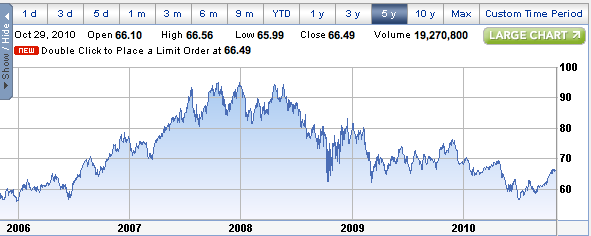 |
| ExxonMobil Stock Price History 2006-2010 |
Those investments have contributed to a lengthy period of unimpressive stock price performance; many investors are convinced that natural gas prices are going to remain low for the foreseeable future. They do not understand why a company that is investing so much money in additional capacity for producing that fuel would be worth their time and money. ExxonMobil decision makers, in contrast, have been investing heavily in XOM stock, with an aggressive stock repurchasing program that has reduced the total number of shares outstanding by 11% since the end of 2006.
Some stock repurchase programs can be seen as attempts by management to keep their stock prices up and earn bonuses not supported by actual performance measures, but I believe that ExxonMobil decision makers are buying stock because they think it is a good investment. There is good reason to believe that the company is investing in natural gas production and distribution capacity because they think that is also a good investment that will pay large dividends in a future where natural gas prices increase more rapidly than other analysts and competitors expect.
Here is a quote from William M. Colton, ExxonMobil’s vice president for corporate strategic planning, that should be read very carefully.
“Everyone likes to talk about oil and transportation because people all drive cars and they like to talk about them. But in energy, its power generation where the big action is. For the big power generation needs of the country, you are really going to need a choice between coal, gas and nuclear.
“While nuclear has an important role to play, you can’t do that fast. And then you have that power generation C.E.O. sitting there, and thinking, for my next big plant should I make it gas or coal? Well, it’s pretty easy if you think there is going to be any risk of a carbon cost, with natural gas being 60 percent cleaner, gas just makes sense.”
There is more information that is worth reading at A Big Bet on Natural Gas, but I want to you go and read it there. One thing I want you to consider is the fact that ExxonMobil has spent enough money since 2002 buying its own stock to have paid cash for 10-20 new nuclear power plants.
Mr. Colton’s statement qualifies as a smoking gun of the “damning with faint praise” genre. I also think it qualifies as the kind of smiling advice you might get from a blackjack dealer who says – “House stands”.
Disclosure: I have recently bet with the house and more than doubled my holdings of Chesapeake Energy. That is my favorite choice of companies that will gain a substantial benefit when natural gas prices in the US increase. I am betting that result is inevitable as power generation company decision makers use currently low prices as a reason build power plants that can only burn gas or even more expensive fuel oil. Many electricity production companies believe they are adequately protected from future fuel fuel price risk by favorable fuel adjustment surcharge rules.

“Well, it
Exxon tried the nuclear fuel business and left (in fact the HTP fuel grid was developed on Exxon’s watch and is a big seller for Areva). As much of a fan of nuclear as I am, fossil fuels are easier to use. Nuclear is doing well in countries that either have limited access to pipeline gas or their electric demand growth is high enough to support nuclear plants. The greenhouse gas issue will help nuclear as well, but this may be a stone age where we have use most of the stones first (despite Sheik Yamani’s opinion).
@Robert – are nuclear fuels easier to use from a physical point of view or do you think they are easier to use taking all obstacles – including those imposed by humans – into account?
As a former nuclear plant operator – I would answer no to the first question and yes to the second question, but I would be interested in your opinion.
I realized, upon re-reading my post, that I had a sort of incomplete thought in the third paragraph, so this post is a correction:
I’ve been thinking about this a lot lately, and I’ve come to the conclusion that, as far as nuclear goes, we definitely want to keep the industry ‘alive’ to the point of viability, so that means at least making sure that every few years a couple plants are built. I don’t think there is enough consensus (at least in the U.S.) about Anthropogenic Climate Change from carbon emissions, to really truly clamp down on NatGas (or, to some extent, Coal, although as above, perhaps coal ‘growth’ will be kept in check by the *threat* of legislative carbon controls), to the point that the country would go in big for nuclear. It may be that the best we can hope for, is to keep the industry alive enough that it can be started up in a big way, easily, when the time comes, and also that the state of the art in design keeps progressing to make safer, cheaper, more practical plants.
How many pro-nuclear people here buy gasoline at Exxon Mobil gas stations?
All this whining over fossil fuels is useless and pointless so long as you agree to purchase their product. Using the excuse “There’s no other way” doesn’t count. Put your principles into action and refuse to buy from fossil fuel.
One other interesting piece of input on the future natural gas question came from the CEO of Shaw Group when he was interviewed on the Creamer (Mad Money) show.
Shaw is an A-E that builds all types of generation. When Creamer asked him why they are specifically interested in nuclear, he spent much of his response specifically talking about the comparison of BTU-equivalent price between gas and oil. Right now, oil is several times as expensive as natural gas, on a per-heat-content basis. The CEO described this situation as uncommon. That is, it will probably not last.
In many types of industrial facilities, either oil or gas could be used. They can also be interchangeable for space heating. Finally, if the spread stays high enough, for long enough, we can use gas for transportation, using natural gas power cars, or by converting the gas to a clean liquid fuel using a gas liquifaction process.
For these reasons, as the cost of oil stays high (or get even higher), due to depletion, the price of oil will eventually drag up the price of gas, as gas starts to be used in place of oil for various applications. Also, as noted, gas will be used in place of coal for power generation. One other thing the Shaw CEO talked about was how (and why) oil rich Gulf nations, that have large gas a oil reserves, were “putting their money on nuclear” for power generation. More evidence of the expectation of increasing world market prices for oil and gas.
@guest – I would say that nuclear fuels are not quite as convenient compared to fossil fuels (e.g., cannot use nuclear reactors to power cars or weedwhackers). Still they are competitive for baeload electricity. Certainly the regulatory barriers can be excessive, but countries without pipeline gas have similar regulations and yet build plants.
I do not buy gasoline at ExxonMobil gas stations, but I do buy diesel fuel there. As I described in my post, I have a great deal of respect for ExxonMobil – they know their business and sell a useful product.
My issue is with the power company executives who do not think too deeply or do much research with regard to the future of fossil fuel prices. They have been convinced by a temporary dip in the market price of a fuel with a long history of volatility that is due partially to its physical volatility. Gas is hard to store, so you only extract what you need. That means that it does not take much of a change in the market for there to be either too little or too much. The total US gas storage capacity is about 3 months worth of normal consumption.
As a matter of principle, I have nothing against using gasoline or diesel fuel. I do have a problem with using them as fast as the fossil fuel companies would like for me to use them. I also have a problem with using up natural gas at the rate that the gas suppliers would prefer. If we could reduce our consumption by a factor of 2, the gas would last twice as long.
I’m wondering why so much information is available about transactions. This company I can understand tthat this information is not so detailed but Constellation and EDP have a lot of details. Is there some law passed that makes there dealing publicly available?
Cheaper and more practical, sure, but nuclear plants don’t need to be safer. They are safe.
One of the major attractions of the current interest (long-time in Rod’s case) in smaller reactors is the chance of deploying them to remote locations, and of building incremental generation. And building them cheaper, because the safety is intrinsic so reduces complexity.
Another challenge is to convince the regulator that safe enough is SAFE ENOUGH. One thing nuclear has been terrible at is accepting regulatory “enhancements” that have no benefit; traditionally because they could, and now because they did before.