
All cost, no benefit – EPA proposes onerous 33 year monitoring requirement for ISR mining
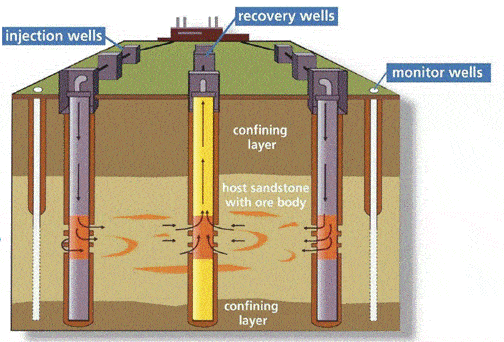
On Jan 26, 2015, the Environmental Protection Agency (EPA) issued a notice of proposed rulemaking that will have the effect — intended or unintended — of eliminating in-situ leach (ISL) uranium mining in the US. The technology, which the EPA choses to call in-situ recovery (ISR), is the dominant technology used by operating mines. Therefore the rule could eliminate most US uranium production.
The rule authors state that they believe that all groundwater in the US, no matter what its initial condition might be, is a valuable resource that must be carefully and expensively protected from 13 naturally occurring constituents — including arsenic, barium, cadmium, chromium, lead, mercury, selenium, silver, nitrate (as nitrogen), molybdenum, radium, total uranium and gross alphaparticle activity — that might be mobilized by the oxygenated water used in the in-site leaching process.
If the rule is implemented as written, each proposed ISR facility would be required to fully characterize the groundwater chemistry throughout the site and along the site boundaries. Characterization is already required, but the specifics are considerably altered to require more time, effort and record keeping.
Following the end of mining operations, the current requirement is to restore the site and monitor it for about six months to demonstrate the success of the restoration.
The new rules add two and a half years of monitoring and statistical analysis to the current requirement to demonstrate that the restoration was successful and that the chemistry in the monitoring wells has reached stability. Once three-year stability monitoring period has ended, the propose rule requires an additional 30-year monitoring period.
At any time during the monitoring period, remediation efforts would be required if any of the 13 measured naturally occurring groundwater constituents listed above exceed the most restrictive limits provided in regulations that implement one of the following acts: the Safe Drinking Water Act (SDWA), the Resource Conservation and Recovery Act (RCRA), or the Uranium Mill Tailings Radiation Control Act of 1978 (UMTRCA).
If those regulations are later revised to impose tighter limits, the new limits would automatically apply to ISR mining.
There is a provision in the rule for using alternative concentration limits, but those may only be approved by the responsible enforcement regulator after the licensee has made “reasonable and satisfactory” efforts to achieve the initially required limits.
The rule freely acknowledges the fact that most areas where ISR mines would be viable have naturally contaminated aquifers that are not suitable for drinking water or irrigation. The authors recognize those conditions existed long before the introduction of oxygenated water aimed at mobilizing uranium for recovery.
EPA bureaucrats don’t believe that is a good reason to avoid making ISR operators responsible for water quality for 33 years after they have stopped mining. (p. 4171)
We anticipate the objection that the presence of uranium deposits typically results in groundwater of poor quality, and not a pristine source of drinking water. We recognize that this is often the case, and that the volume of water affected by the mineralized zone may be significant. We do not, however, see this as a reason to allow this groundwater to be further degraded.
The rule includes a provision that probably will encourage current mines to cease operations and immediately begin restoration processes if it appears that the rule will be implemented as written.
Upon promulgation, licensees currently in restoration, stability monitoring or long- term monitoring at a given wellfield at a licensed facility would continue to be held to the standard(s) in place at the time of licensing for those given wellfield(s), unless the regulatory agency determines otherwise. Operating wellfields, new wellfields and expansions of wellfields would be required to meet the newly promulgated standards.
(http://www.gpo.gov/fdsys/pkg/FR-2015-01-26/pdf/2015-00276.pdf p. 4172)
The rule authors conducted some financial analysis with models built on data extracted from three existing small businesses. They determined that the rule imposes additional cost on small businesses, but the increases would be no more than about 1.7% of projected 2015 revenues.
They also surveyed the industry and found that the rule would affect no more than 10 small businesses. Those findings enabled the rule authors to conclude that their proposal “would not result in significant impacts for a substantial number of small entities.” (IBID p. 4157)
There is feeble attempt in the discussion about the rule to provide a qualitative cost benefit analysis. Almost amusingly, the analysis calculates projected annual cost to a precision of three significant digits, but states that the benefits cannot be quantified.
It acknowledges that the aquifers the rule is supposed to protect are not currently used as sources for drinking water or irrigation, that they are located in remote areas where there are few, if any people, and that they are often difficult to access.
It attempts to justify taking action by documenting an assumption that the value of each early death by cancer that is avoided would be worth at least $8 million, but it makes no attempt to calculate how many avoided cancer deaths might result from imposing the new rules.
The largest numbers in the benefit column come from a convoluted assertion that the required monitoring regime will result in early corrective action for any detected excursion and that early action will result in a cost saving compared to the action that might be required if the excursion is somehow discovered much later.
The proposed rule would be implemented by adding a new subpart F to 40 CFR 192, Health and Environmental Protection Standards for Uranium and Thorium Mill Tailings. The full notice) is 33 pages long, so the EPA has produced a 2 page summary document.
Comments about the proposed rule must be submitted on or before April 27, 2015. There was a public hearing held in Washington DC on March 10, 2015 and there are plans to hold hearings in Wyoming and Texas. The date and location for those hearing has not been announced. Updates are available.
The above linked site also includes links to register for update notices, links to background documents, and instructions for comment submittals.
Does anyone know what the post restoration requirements are for oil and gas wells? Do they even have to restore the site before they pull chocks? (Sorry, that’s a bit of Navy slang for “depart.”)
PS – Budgeteers at the NRC should take notice of the substantial burden that their sister agency is proposing to impose upon their agency. Under the current framework for regulating radioactive materials, the EPA is given the authority to write environmental and radiation protection standards, but the responsibility for enforcing them falls on the NRC. Enforcing 33 year long monitoring periods will create ongoing budget requirements and perhaps a few career opportunities for people who like roaming around very lightly populated areas.


“It acknowledges that the aquifers the rule is supposed to protect are not currently used as sources for drinking water or irrigation, that they are located in remote areas where there are few, if any people, and that they are often difficult to access.”
But because some of those areas are close to Telluride CO, there’s a lot of money behind making sure no mining activity can ever “spoil” the landscape.
http://www.wise-uranium.org/upusaco.html (scroll down to Prince Albert Mine).
The same thing happened in Pitkin county (Aspen), when the BLM began the process of opening up the Thompson Divide area to gas well drilling. The local residents quickly created an opposition group and got so many restrictions in place that I think they just gave up.
The uranium industry around southwestern Colorado and Utah is the subject of a “documentary” I’m sure many of you have heard of, Uranium Drive-in. An extremely wealthy minority in the state is doing whatever they can to protect their land values (under the dubious assumption that large vehicles and activity will affect prices), at the expense of the working poor, under the guise of protecting the environment from certain peril.
Here’s a Wikepedia link for this type of mining:
http://en.wikipedia.org/wiki/In_situ_leach
Another link on heap leaching:
http://en.wikipedia.org/wiki/Heap_leaching
This one notes that there have been environmental problems in the past with mining uranium in this manner. Three examples are given, ” The Rum Jungle Mine”, “The Ranger Uranium Mine,: and “Fort Belknap.”
Some communities such as Leadville, Colorado have faced difficulties due to heavy metals from former mining operations entering the water supply. My grandfathers were both miners. We need mining. We do not need our environment destroyed in the process. Places like Butte, Anaconda and Sudbury give examples of what may go wrong without environmental protection.
Have the fears of past mistakes prompted an overreaction to over-regulate mining operations? Using Baking Soda (Sodium Bicarbonate) to dissolve Uranium Oxides doesn’t sound too frightening. It seems much more safe than cysnaide used for other metals. I have to agree with the bureaucrats though that just because the water is already bad is not an adequate reason to make it worse.
Sounds like someone in the EPA has misinterpreted Aldo Leopold’s land ethic to apply to naturally contaminated aquifers. ;-). The key is for EPA to apply the same yardstick to all the energy forms. Do the coal, oil, and gas industries have to follow rules extracting their minerals that convey similar magnitudes of risk? If not, why is it acceptable to challenge the environment and public health on a higher scale with fossil fuels than nuclear? Yes there are uncertainties in measuring and evaluating risk, but we must resist the default “it’s nuclear” when assigning regulatory changes.
I fully agree with you Robert. If these rules are made to stick for Uranium mining, but similar rules are not applied for fracking and other means of extracting hydrocarbons or coal……..then there is clearly a bias.
Additionally, the complete lack of attempting to quantify the number of hypothetical cancers (likely zero even with a full LNT plus collective dose methodology) avoided is a failure of this proposed regulation.
“Does anyone know what the post restoration requirements are for oil and gas wells? Do they even have to restore the site before they pull chocks? (Sorry, that’s a bit of Navy slang for “depart.”)”
Leach mines are like 200 meters deep, many shale oil wells are over 3200 meters.
Aquifers tend to be between those two depths.
So shale oil wells just have to make sure the casement in the borehole section that could leak into the aquifer are well built during the initial frack and pumping. After the well is abandoned, it doesn’t matter. There’s no risk.
Link for shale oil well depths:
http://www.hexionfracline.com/case-histories-haynesville-fayetteville-and-bakken-shales
@NewtonPulsifer
Note that my question was not limited to modern, well-built shale wells.
I don’t agree with the “no risk” statement. A search on “abandoned gas wells” brings tens of thousands of returns, including links to state public health agency sites, etc.
Here is just one example news story. http://stateimpact.npr.org/pennsylvania/tag/perilous-pathways/