
NS Savannah tours May 18, 2014
Press Release
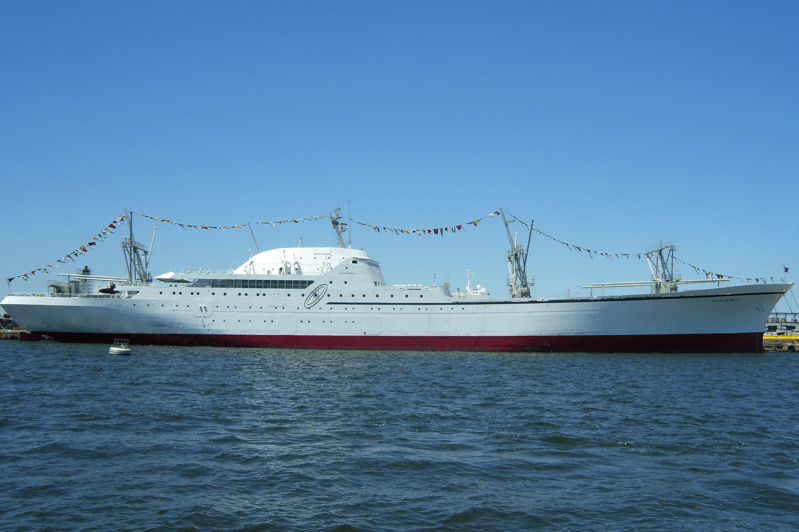
Historic Ship N.S. Savannah Open for Tours May 18, 2014 in Observance of Maritime Day
N.S. Savannah Association, Inc. 4/17/2014
The unique, nuclear powered ship N.S. Savannah will be opened for tours at her pier in Baltimore, Md. on Sunday, May 18, 2014 as a part of the annual commemoration of Maritime Day.
During the hours of 10:00 AM – 3:30 PM, visitors will be offered a rare opportunity to view this beautiful and historic vessel.
“This day pays special tribute to the people who served as merchant mariners in service to their country as well as to the benefits that the maritime industry provides for the United States,” says Bob Moody, President of the N.S. Savannah Association Inc. and former licensed reactor operator on the ship. “We’re pleased that the Port of Baltimore hosts visitors on these occasions, and that the U.S. Maritime Administration opens the ship for the day for tours so that people can see just how unique and beautiful the ship is, inside and out.”
N.S. Savannah Association members will be on board during the weekend, providing information to visitors from a unique perspective – that of having worked on the ship. The Association serves to assist in preservation of the ship, as well as public education about the ship and its history. The ship is owned by the U.S. Maritime Administration.
Maritime Day, declared as a holiday by joint act of Congress in 1933, was set as May 22 as that is the day in 1819 on which the steamer Savannah left on the first successful transatlantic voyage by a steam-powered vessel. In honor of that pioneer, the keel of N.S. Savannah was laid on Maritime Day in 1958.
The ship is located at Canton Marine Terminal Pier 13, 4601 Newgate Avenue, Baltimore, MD 21224.
Media contact:
Will Davis
Communications Director, N.S. Savannah Association
atomicpower@willdavis.org
216-544-3808
This press release came with fortuitous timing for Atomic Insights, considering the fact that the most recent prior post was about a special tour of the NS Savannah. I hope some of you can take advantage of the opportunity.


http://www.counterpunch.org/2014/04/18/climate-change-meets-high-tech/
Excerpt….
One solution to the fossil fuel conundrum is energy from water. Energy derived from the elements found in water has far-reaching potential. In that regard, the U.S. Naval Research Laboratory’s Materials Science and Technology Division announced they have achieved ‘proof of concept’ for a new technology that may be a game changer.
The new process extracts carbon dioxide and hydrogen from seawater, which are processed in a catalytic converter to transform the elements into a liquid hydrocarbon fuel with 92% efficiency. This fuel can be used to power conventional engines already in use today. The catalytic device is described as an “innovative and proprietary NRL electronic cation exchange module or “E-CEM.”
Naval scientists demonstrated the novel concept on April 2, 2014 with a model airplane powered by fuel from seawater. “This is the first time technology of this nature has been demonstrated with the potential for transition, from the laboratory, to full-scale commercial implementation,” according to Naval research chemist Heather Willauer, Scale Model WWII Craft Takes Flight With Fuel From the Sea Concept, America’s Navy, Naval Research Laboratory Public Affairs, Story No. NNS14040704, Release Date: 4/7/2014.
Looking ahead into the future, the Navy predicts seawater fuel will cost $3-6 per gallon, and it could be available on a commercial scale within 10 years.
Any information on the energy density? If it is similar to gasoline, the price of this seawater fuel is $1000 – $2000 per tonne. Excellent price to keep nuclear propulsion economical for ships.
Don’t know any more than you do. Probably less. Just found the article kinda interesting. I emailed the author, in the hopes he might join with any comments.
The fuel created it JP5 as far as I know. There are papers from the Navy floating around online with all of the calculations. Right now carriers have unlimited propulsion fuel and food for months, but have to get more jet fuel for their aircraft very frequently (I believe less than 1 week). If they can make their own, they cut off that entire, expensive supply chain and the corresponding weakness it introduces in wartime.
Looks like I didn’t scroll down far enough before replying!
Paper:
http://www.dtic.mil/cgi-bin/GetTRDoc?AD=ADA539765